
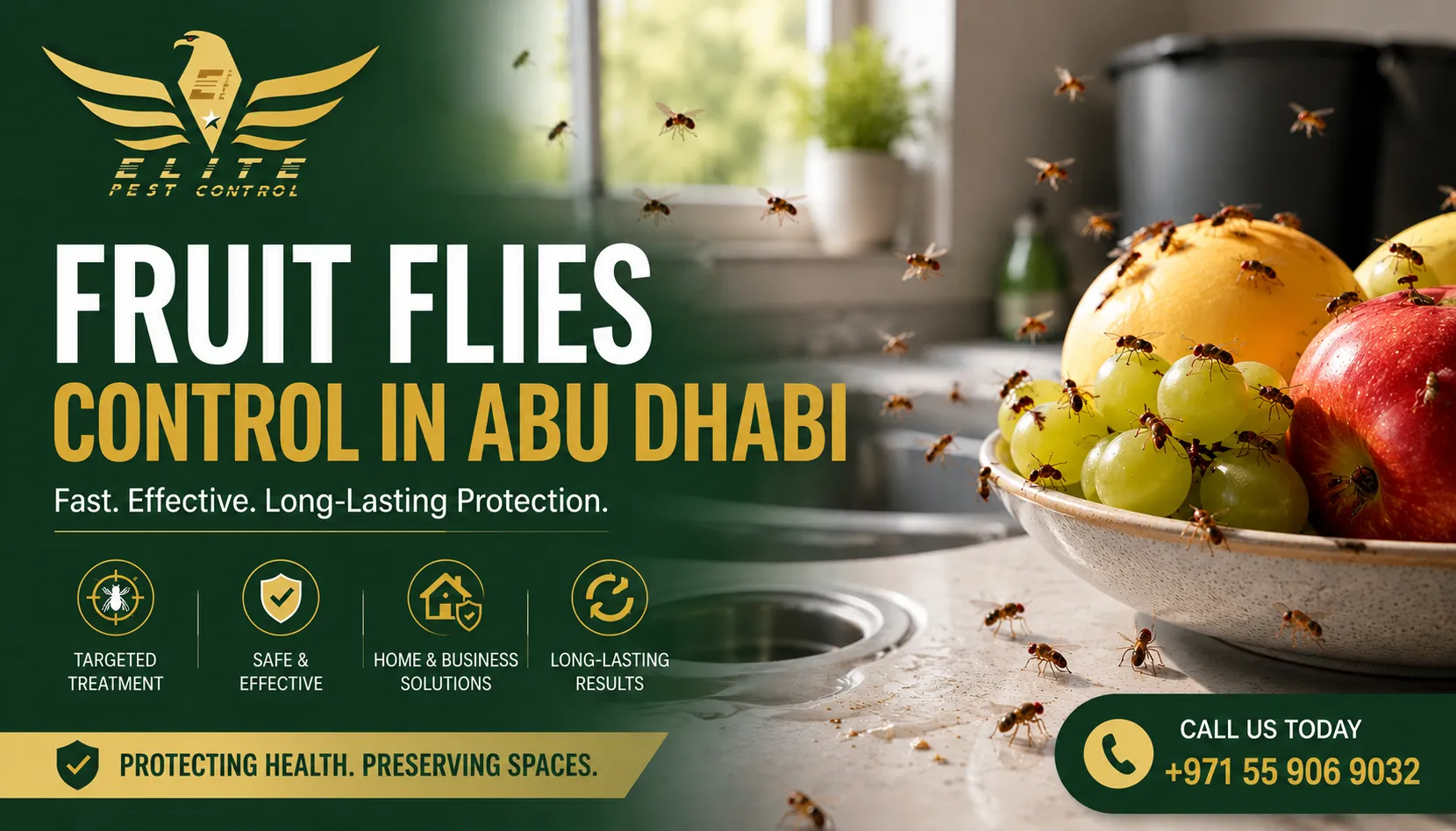
You notice one. Then two. Then suddenly your kitchen counter, your fruit bowl, your sink drain, and your bin area are all moving with tiny, hovering insects that seem to appear from nowhere and disappear nowhere when you try to catch them.
Fruit flies in Abu Dhabi are one of the most frustrating pest problems a household or food business can face. They are fast, resilient, and remarkably good at reproducing faster than you can eliminate them. A single female fruit fly lays up to 500 eggs in her short lifetime. At Abu Dhabi’s year-round temperatures, those eggs hatch in under 24 hours. Within a week, a new generation is airborne.
Understanding what fruit flies are, why they thrive so aggressively in the UAE, and what actually works — versus what wastes your time — is the starting point for solving the problem permanently.
This complete guide covers everything: the difference between fruit flies and other small flies, the health risks they carry, how professional fruit fly spray treatment works, why DIY products consistently disappoint, how restaurants and commercial kitchens handle the problem, and how to keep fruit flies out of your Abu Dhabi property for good.
What Are Fruit Flies and Why Are They Such a Problem in Abu Dhabi?
Fruit flies — most commonly Drosophila melanogaster and related species — are small flies belonging to the family Drosophilidae. Adult fruit flies are typically 3–4 mm in length, tan or yellowish-brown in colour, with distinctive bright red eyes that are visible under magnification. They are attracted primarily to fermenting organic matter: overripe fruit, vegetable waste, spilled juice, alcoholic beverages, vinegar, and the organic residue that builds up inside drains, bins, and cleaning mop heads.
In cooler countries, fruit fly activity is largely seasonal — peaking in late summer when fruit is ripening and temperatures are warm. In Abu Dhabi, the situation is fundamentally different. With year-round temperatures rarely dropping below 15°C even at night, and summer temperatures regularly exceeding 40°C, fruit fly breeding is a 365-day-a-year activity. There is no cold season to interrupt the lifecycle, no frost to kill off populations, and no natural break in which kitchens, restaurants, and food storage areas get relief.
This is why fruit fly infestations in Abu Dhabi can scale from a handful of insects to thousands within a matter of days — and why an infestation that is ignored for even a short period becomes significantly harder to control.
Abu Dhabi’s food culture adds to the problem. The abundance of fresh produce markets, traditional food preparation with overripe dates and fermenting foods, busy restaurant and hospitality sectors, and dense residential compounds with shared waste management areas all create ideal conditions for fruit fly populations to establish and thrive.
What Is the Difference Between Fruit Flies and Other Small Flies in Abu Dhabi?
Not every small fly hovering near your kitchen is a fruit fly. Misidentification leads to choosing the wrong treatment — and getting no results. These are the small fly species most commonly confused with fruit flies in Abu Dhabi:
Fruit Flies (Drosophila spp.) — The classic fruit fly. Small (3–4 mm), tan-brown body, red eyes, seen hovering around fruit bowls, overripe produce, spilled juice, wine glasses, and compost. Breed primarily in fermenting organic matter and overripe fruit. Most active around food preparation areas and produce storage.
Drain Flies (Moth Flies — Psychoda spp.) — Slightly larger than fruit flies (2–5 mm), fuzzy appearance like a tiny moth, dark grey or brown body with hairy, leaf-shaped wings held flat over the body when at rest. Breed exclusively in the organic film (biofilm) that coats the interior of slow-moving or stagnant drains, pipe walls, and sewage systems. Most commonly seen near bathroom drains, kitchen sink drains, and floor drains in commercial kitchens. Easily confused with fruit flies but require completely different treatment — targeting drains rather than food sources.
Phorid Flies (Humpbacked Flies — Megaselia spp.) — Small (0.5–6 mm), distinctive humped thorax when viewed from the side, dark brown to black body. Breed in a wide range of decaying organic matter including decomposing plant material, food waste, faecal matter, and occasionally animal carcasses. They run rapidly across surfaces rather than hovering — a distinguishing behaviour. Phorid flies in commercial settings can indicate drainage problems, leaking sewage pipes, or buried organic matter under flooring.
Fungus Gnats (Bradysia spp.) — Black, mosquito-like small flies (2–3 mm) with long legs and antennae. Breed in the moist soil of potted houseplants — specifically in the algae and fungus that grow in consistently overwatered compost. Seen hovering around indoor plants and window sills. Not a food area pest but frequently brought into Abu Dhabi properties in new potted plants.
House Flies (Musca domestica) — Much larger than fruit flies (6–8 mm), grey body with four dark stripes. Included here because many Abu Dhabi residents describe any fly problem as “fruit flies.” House flies require entirely different control strategies. Our flies and mosquitoes control service covers both house flies and fruit flies with targeted treatment for each.
Correct identification before choosing a treatment is essential. If you are not certain which species you have, contact Elite Defence for a free identification visit — treating for the wrong fly wastes time, money, and product.
Why Do Fruit Flies Invade Abu Dhabi Homes and Businesses So Aggressively?
Several factors specific to Abu Dhabi properties and the UAE food environment drive fruit fly infestations to the scale they reach here:
Year-round heat accelerates the lifecycle. At 25°C, a fruit fly completes its lifecycle — from egg to adult — in approximately 8–10 days. At Abu Dhabi’s summer temperatures of 35–42°C, that lifecycle compresses to as little as 5–7 days. This means that if breeding sources are not eliminated, new adult populations are emerging faster than any spray treatment can kill them.
Open fruit storage. In many Abu Dhabi homes, particularly in households that buy fresh produce from souks and traditional markets, large quantities of dates, mangoes, bananas, tomatoes, and citrus fruits are stored at room temperature. In Abu Dhabi’s heat, fruit ripens and ferments rapidly. A bowl of bananas that would stay fresh for a week in a cooler climate may begin fermenting within 2–3 days at room temperature in an Abu Dhabi kitchen.
Organic residue in kitchen drains. Kitchen drain pipes accumulate a film of organic matter — food particles, grease, sugars, and fermented residue — on their interior walls. In Abu Dhabi’s warm conditions, this organic layer ferments rapidly, creating a permanent breeding site that continuously produces new fruit fly populations even when all surface food sources have been removed. This is the most common reason why DIY treatments fail — the drain source is never addressed.
Restaurant and food business density. Abu Dhabi’s dense hospitality and food service sector — restaurants, food courts, catering operations, hotel kitchens — creates high concentrations of organic waste, busy drains, and open food handling that generate fruit fly pressure on surrounding properties. A residential building near a busy restaurant row in Abu Dhabi is exposed to a much higher fruit fly load than an isolated property.
Shared waste management areas. In apartment buildings and residential compounds, shared waste collection points concentrate organic waste from many units. Bins that are not emptied frequently, or that are not properly sealed, become breeding hubs that seed the entire building complex with adult fruit flies.
Poor bin hygiene. Even in well-managed kitchens, the bin itself — particularly the lid and rim where juice and food residue accumulates — is a breeding site. Female fruit flies lay eggs on organic residue in the smallest crevice of a bin that is not regularly and thoroughly cleaned, not just emptied.
What Are the Signs of a Fruit Fly Infestation in Your Abu Dhabi Home?
Recognising an infestation early is critical — the smaller the population, the faster it can be resolved. These are the clear indicators:
Hovering insects near food. The most obvious sign — small tan-brown flies hovering near fruit bowls, vegetable storage, the kitchen counter, the sink area, or the bin. Fruit flies hover in small circles rather than flying in straight lines, which distinguishes them from house flies.
Flies concentrated around drains. If you notice flies clustering near kitchen or bathroom drain openings, particularly at night or early morning when activity is highest, drain breeding is likely. Drain flies and fruit flies both use drain environments, though the specific breeding mechanism differs.
Flies near the bin. A cloud of small flies that rises when you open your kitchen bin is a classic fruit fly indicator. The bin interior, bin lid, and any juice or food residue at the base of the bin are active breeding sites.
Flies near alcohol or fermented drinks. Fruit flies are strongly attracted to wine, beer, spirits, vinegar, and fermented beverages. Seeing flies around open bottles, wine glasses, or a bar area is a diagnostic indicator.
Larvae in overripe produce. In heavy infestations, fruit fly larvae (tiny white maggots, 3–4 mm) may be visible in or on severely overripe or rotting fruit. Finding larvae confirms active breeding on the fruit itself.
Persistent flies despite cleaning. If you have cleaned the kitchen thoroughly, removed all visible fruit, and still have flies, the breeding source is somewhere less obvious — inside the drain pipe, under the fridge drip tray, in the waste disposal unit, or in organic residue around a poorly sealed cupboard.
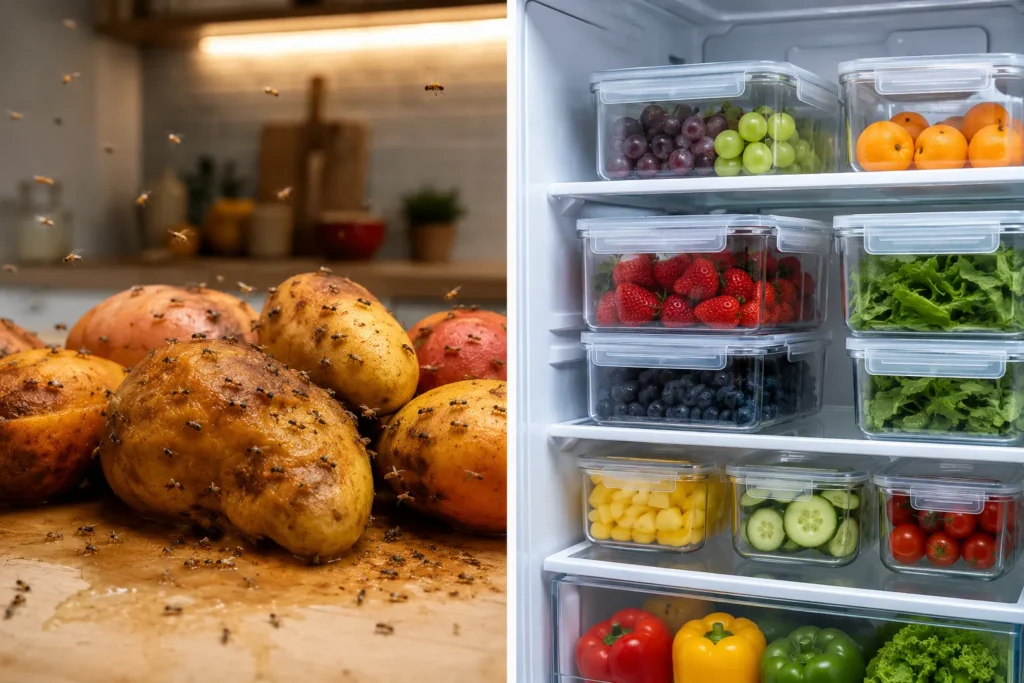
What Health Risks Do Fruit Flies Actually Carry?
Fruit flies are often dismissed as merely annoying. This underestimates the genuine health concern they represent, particularly in food preparation environments:
Pathogen transfer. Fruit flies breed in decaying organic matter and sewage residues. Their legs, body, and mouthparts carry bacteria, fungi, and viruses collected from these breeding environments. Studies have documented fruit flies carrying E. coli, Salmonella, Listeria, and various other food-borne pathogens on their bodies. Every time a fruit fly lands on your food preparation surface, your food, or your cooking equipment, it deposits these pathogens.
Contamination of food. Unlike cockroaches — which are well understood as food contaminants — fruit flies tend to be perceived as harmless. This perception means that contaminated food is more likely to be consumed without awareness of the risk. A fruit fly that has been breeding in a drain and then lands on a salad or piece of fruit represents a genuine contamination event.
Spoilage acceleration. Fruit flies spread the yeasts and moulds that cause fruit and vegetable spoilage. A fly landing on undamaged fruit and depositing yeast spores dramatically accelerates fermentation and rotting. In a household or commercial setting, this translates directly to food waste and economic loss.
HACCP and food safety compliance. In commercial food businesses in Abu Dhabi — restaurants, catering companies, supermarkets, hotels, food processing facilities — the presence of fruit flies is a food safety violation. Inspections by Abu Dhabi Municipality food safety teams regularly flag fly infestations as critical non-conformances under HACCP guidelines. The consequences include improvement notices, temporary closure orders, and regulatory action. Our flies and mosquitoes control service provides HACCP-compliant treatment specifically designed for commercial food environments.
Allergic reactions. Repeated exposure to fruit fly bodies and their metabolic byproducts can trigger allergic responses in sensitive individuals — skin irritation, respiratory reactions, and eye irritation. In households where a member has existing allergies or asthma, a persistent fruit fly infestation has health implications beyond simple annoyance.
What Is Fruit Fly Spray and How Does It Actually Work?
Fruit fly spray is the collective term for insecticide formulations applied to surfaces, breeding areas, and the air to kill adult fruit flies and — in some products — target larvae and eggs at breeding sites.
Understanding how different spray types work helps you evaluate their limitations:
Contact aerosol sprays. These are the most familiar format — pressurised cans that spray a fine mist of insecticide into the air or onto surfaces. They kill fruit flies on contact when the insecticide lands directly on the insect. Contact sprays are effective at reducing visible adult populations in the short term but have no lasting residual activity. The moment the spray disperses or dries, new adults emerging from untreated breeding sites replace the ones killed. Without eliminating the breeding source, contact sprays are a temporary cosmetic fix.
Residual surface sprays. Applied to surfaces where fruit flies rest and land — walls near drains, bin lids, counter edges, under the sink — residual sprays leave an active insecticide film that kills flies for days or weeks after application. More effective than aerosols as part of a treatment programme, but still dependent on addressing the breeding source to achieve long-term elimination.
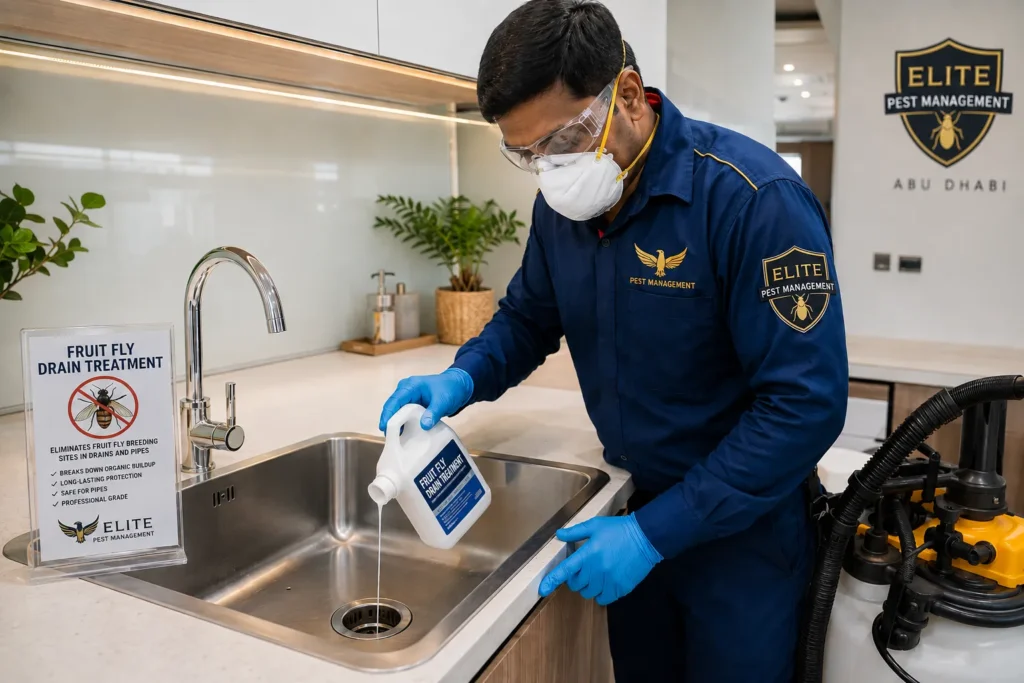
Drain treatments and gel formulations. Specifically formulated to target the organic biofilm inside drain pipes where fruit flies and drain flies breed. These products — typically enzyme-based cleaners combined with an insect growth regulator or adulticide — break down the organic material inside the drain while killing larvae. This is the most important category of product in any serious fruit fly treatment, because it addresses the source rather than just the adult population.
Insect growth regulators (IGRs). IGRs are compounds that disrupt the development of immature insects — preventing larvae from maturing into breeding adults. Applied to breeding areas, IGRs break the reproductive cycle without relying solely on killing adult insects. When combined with adulticide sprays, they significantly improve the speed and completeness of treatment.
Fogging treatments. Thermal or cold foggers disperse insecticide as a fine mist that penetrates the entire volume of a room — reaching areas that direct spray cannot. Fogging is used in severe infestations, in large commercial kitchens, and in areas where conventional spraying is impractical. It provides rapid knockdown of large adult populations but must be combined with source treatment to prevent rapid recurrence.
Bait stations and traps. Non-chemical fly traps — using food-based attractants or UV light — catch and kill adult flies without dispersing chemicals. Traps are useful as monitoring tools and as supplementary control in food areas where chemical application must be minimised, but they are not standalone solutions for an active infestation.
Do DIY Fruit Fly Sprays Work — Or Are They a Waste of Time and Money?
This is one of the most commonly asked questions — and the honest answer is that DIY fruit fly sprays provide temporary relief but almost never eliminate an infestation permanently. Here is why:
DIY products address adults, not the source. Every consumer fruit fly spray on the UAE market is designed to kill adult flies on contact or at rest. None of them penetrate drain biofilm, reach eggs inside fermented fruit, or disrupt the breeding cycle inside hidden organic residue. Killing the adults you can see while leaving the breeding source intact is like mopping a floor while the tap is still running.
Incorrect product selection. Without professional identification of the species and breeding locations, DIY treatments are often applied to the wrong areas with the wrong product. Spraying a fruit fly aerosol near drain openings does nothing for the larvae breeding in the pipe below. Using a drain cleaner intended for blockages does not eliminate the organic biofilm layer that fruit flies breed in.
Concentration and application issues. Consumer products are formulated at concentrations suitable for occasional household use — not for active infestations. Professional-grade insecticides use higher active ingredient concentrations, better penetrating formulations, and delivery equipment that ensures full surface coverage.
The smell of homemade traps does not stop breeding. Popular DIY methods — apple cider vinegar traps, red wine traps, dish soap bowls — catch some adult fruit flies, reducing visible numbers slightly. They do nothing to address larvae, eggs, or breeding in drains and organic residue. They are monitoring tools at best.
Without treatment plan, re-infestation is inevitable. Fruit fly populations in an Abu Dhabi property that has active breeding sites will self-replenish within days of any treatment that does not eliminate those sites. The cycle of spraying and reappearance is a common frustration that ends only with professional source identification and targeted treatment.
What Is the Professional Fruit Fly Treatment Process — Step by Step?
When Elite Defence carries out professional fruit fly treatment in Abu Dhabi, the process is systematic, thorough, and designed to resolve the infestation at its source:
Step 1: Identification and Assessment. A trained technician visits the property and carries out a full assessment. The fly species is positively identified. All breeding sites are located — this typically includes inspection of all drains, bin areas, food storage areas, the area behind and beneath kitchen appliances, waste disposal units, mop storage areas, and any areas where organic matter may have accumulated in hidden spaces. Every confirmed and suspected breeding site is mapped before treatment begins.
Step 2: Source Elimination Preparation. The client is advised to remove all overripe or suspect produce, thoroughly empty and clean the bin, and clear under-sink and appliance areas before treatment. Source preparation by the client maximises the effectiveness of treatment — professional spray applied on top of active breeding material is compromised.
Step 3: Drain Treatment. Drains are treated first. A combination of enzymatic biofilm-breaking solution and insect growth regulator is applied to all kitchen, bar, and service drains. The product is applied in a controlled manner that ensures it coats the interior pipe walls — not just poured through and flushed away. Drain treatment may need to be repeated at follow-up visits for heavily infested drain systems.
Step 4: Surface Residual Spray Application. Residual insecticide spray is applied to all surfaces where adult fruit flies rest and breed: bin areas, under-sink cupboards, the back wall and splash areas of counters, the perimeter seal around appliances, and wall areas near drains. These applications deposit a film of active insecticide that continues to kill flies for days after the visit.
Step 5: Space Treatment Where Required. In severe infestations or large commercial kitchens, space treatment — fogging or ULV (ultra-low volume) application — is used to achieve rapid knockdown of the adult population throughout the space. This is carried out with the area vacated, after which the required re-entry time is observed before the space is returned to use.
Step 6: Insect Growth Regulator Application to Breeding Zones. IGR formulation is applied to confirmed and suspected breeding areas — including inside bin cavities, under appliance drip trays, and to any other organic residue areas identified during assessment. The IGR disrupts larval development, preventing the next generation from reaching reproductive adulthood.
Step 7: Post-Treatment Advice and Prevention Guidance. Following treatment, the technician provides specific recommendations for the property — covering bin hygiene, produce storage, drain maintenance intervals, and any structural or management changes that will prevent recurrence.
Step 8: Follow-Up Visit. A follow-up inspection is scheduled — typically 7–10 days after initial treatment — to assess whether the infestation has been fully resolved, retreat any active breeding sites that remain, and confirm the outcome.
How Do You Get Rid of Fruit Flies in the Kitchen Permanently?
The kitchen is the heart of any fruit fly infestation. Permanent elimination requires addressing every potential breeding source systematically — not just spraying adults:
Drain maintenance is non-negotiable. The kitchen sink drain, the dishwasher drain, and any floor drain in the kitchen are the most common permanent breeding sites for fruit flies in Abu Dhabi kitchens. Weekly treatment of drains with an enzymatic cleaner — not a standard drain unblocking product — breaks down the organic layer that fruit flies breed in. This is the single most important maintenance step.
No overripe fruit at room temperature. In Abu Dhabi’s heat, any fruit that is approaching ripeness should be stored in the refrigerator. Overripe bananas, bruised mangoes, soft tomatoes, and fermenting dates are ideal breeding material. If you keep a fruit bowl, it should contain only fully fresh produce that is rotated daily.
Clean the bin, not just empty it. The inside of your kitchen bin — particularly the base and the inner rim of the lid — accumulates juice, residue, and organic matter that is invisible once the new bag goes in. The bin interior must be washed with hot water and disinfectant weekly. The area where the bin sits should also be cleaned regularly.
Check the fridge drip tray. The drip tray beneath a refrigerator accumulates water, food particles, and mould over time. In Abu Dhabi properties where the fridge is used heavily and the kitchen is warm, this tray can become a significant breeding site. Pull the fridge forward and clean the drip tray with hot water and disinfectant at least monthly.
Clean behind and beneath appliances. The areas behind the refrigerator, beneath the cooker, and around the dishwasher accumulate food residue, grease, and spilled organic matter that is not accessible in daily cleaning. These areas should be cleaned thoroughly at regular intervals — at minimum quarterly.
Wine, vinegar, and juice bottles. Open wine bottles, vinegar jars with residue on the outside, and juice bottle caps that have not been wiped down are all fruit fly attractants. In Abu Dhabi kitchens, these should be sealed when not in use and wiped down at the cap and neck regularly.
Mop and cleaning equipment hygiene. Damp mop heads, dirty cleaning cloths, and wet sponges left in kitchen environments are breeding sites that are frequently overlooked. Mop heads should be thoroughly rinsed, wrung, and hung to dry — or replaced — at regular intervals.
How Do You Eliminate Fruit Flies in a Restaurant or Commercial Kitchen in Abu Dhabi?
For Abu Dhabi’s food service businesses — restaurants, hotel kitchens, catering facilities, food courts, and bakeries — fruit fly control is not just a comfort issue. It is a legal compliance requirement and a direct risk to business reputation.
The commercial kitchen fruit fly challenge. Commercial kitchens generate concentrated volumes of organic waste continuously through service hours. Multiple floor drains, vegetable prep sinks, dish-washing stations, grease traps, waste holding areas, and organic waste bins create dozens of potential breeding sites. Staff turnover means hygiene training must be continuous. Deliveries of fresh produce bring new fly eggs into the kitchen environment regularly.
HACCP compliance requirements. Abu Dhabi Municipality food safety inspections assess fly control as part of HACCP compliance. An active fruit fly infestation in a food preparation area is a critical non-conformance — one that can trigger improvement notices, reinspection, and reputational damage on public inspection disclosure platforms. Professional pest control treatment records, visit reports, and ongoing monitoring documentation are part of a complete HACCP compliance file.
Professional service schedule for commercial kitchens. Effective fruit fly management in a commercial kitchen requires a scheduled professional treatment programme — typically monthly treatment visits combined with weekly drain maintenance, supported by professional-grade fly monitoring systems (UV or pheromone traps that provide early warning of population build-up).
Grease trap maintenance. Grease traps in restaurant drainage systems accumulate enormous quantities of organic material and are among the most productive breeding sites for drain flies and phorid flies in commercial properties. Regular professional grease trap maintenance — not just basic cleaning — is essential alongside fly treatment.
Staff hygiene training. No professional spray programme fully compensates for poor staff hygiene practices. Food businesses that invest in regular staff training on bin management, produce handling, drain clearing, and surface cleaning consistently achieve better pest control outcomes than those that rely on professional treatment alone.
Our flies and mosquitoes control service for commercial properties includes HACCP-compatible treatment protocols, full visit documentation, and scheduled maintenance programmes designed for the demands of Abu Dhabi’s food service sector. We also handle the broader commercial pest picture — including cockroach control, rodent control, and all other pest species that affect food business compliance — under a single ongoing contract.
What Are the Best Fruit Fly Prevention Methods for Abu Dhabi Homes?
Prevention is significantly easier than elimination. These are the most effective prevention practices for Abu Dhabi residential properties:
Refrigerate ripening produce. In Abu Dhabi’s climate, any fruit or vegetable that is not going to be consumed within 24 hours should be refrigerated. The fridge is the single most effective barrier between your produce and fruit fly breeding.
Treat kitchen drains weekly. Apply an enzymatic drain treatment product to your kitchen sink drain once a week — particularly during summer. This prevents the organic biofilm buildup that is the primary indoor breeding site. This step alone eliminates the most common cause of persistent indoor fruit fly infestations in Abu Dhabi homes.
Use sealed bins with no exposed organic waste. Your kitchen bin should have a tight-fitting lid and be emptied daily during summer. In Abu Dhabi’s heat, a bin containing organic waste left overnight generates enough fermentation to support fruit fly egg-laying.
Clean up spills immediately. Spilled juice, wine, or any fermented liquid on counters, under appliances, or on shelves should be cleaned immediately with hot water and detergent. Do not leave organic residue to dry on surfaces — it remains an attractant even when no longer visibly wet.
Check incoming produce. Fruit and vegetables brought in from markets, souks, or supermarkets may already carry fruit fly eggs on their surface. Before storing produce at room temperature, inspect it and consider briefly rinsing fruit in clean water.
Fit drain covers. Mesh drain covers on kitchen and bar drains act as a physical barrier to adult flies entering the drain for egg-laying. They also make it easier to keep drains clear of food particles.
Maintain window and door fly screens. Damaged or missing fly screens on kitchen windows are an open entry point for adult fruit flies from outdoor sources — overripe produce in bins outside, composting areas, and neighbouring food businesses. Check screens are intact and well-fitted, particularly in summer months.
Schedule annual professional pest inspection. Even properties without an active infestation benefit from an annual professional pest inspection that assesses drain conditions, potential breeding sites, and overall pest vulnerability. Early identification of conditions that could lead to an infestation is always more economical than treating an established one.
How Long Does Fruit Fly Treatment Take to Work?
This is one of the most common questions from Abu Dhabi residents who have just had professional treatment carried out. The answer depends on the severity of the infestation and whether all breeding sources have been successfully identified and treated:
Immediate adult knockdown. Adult fruit flies exposed to spray treatment during the service visit are typically knocked down within minutes to hours. A significant reduction in visible adult numbers should be noticeable on the day of treatment.
Full resolution: 7–14 days. Because eggs and larvae in breeding sites continue to develop and emerge as adults for up to 7 days after treatment, it is normal to still see some fly activity in the week following a professional service. This is not treatment failure — it is the lifecycle playing out for the generation that was already in the pipeline at the time of treatment. The key indicator is whether numbers are declining day by day.
When activity persists beyond 14 days. If fly numbers are not clearly declining two weeks after professional treatment, a breeding source has not been fully addressed. This is the situation that follow-up visits are designed for. Additional drain treatment, inspection of newly identified areas, or structural investigation (such as checking for organic material trapped under flooring) may be required.
In heavily infested commercial kitchens. Large-scale commercial infestations with multiple breeding sites across a large kitchen environment may take 2–4 weeks of combined treatment and management change to fully resolve. The process is faster when the business has cooperated fully with the hygiene recommendations provided by the pest control technician.
Can Fruit Flies Come Back After Professional Treatment?
Yes — if the conditions that supported the infestation are not permanently changed. This is the critical point about fruit fly control: treatment eliminates the current infestation, but prevention prevents the next one. The most common reasons for recurrence include:
Drain biofilm regrowth. Even after professional drain treatment, organic biofilm begins to rebuild inside drain pipes within weeks if no ongoing maintenance is carried out. Monthly enzymatic drain treatment after the initial professional service is the standard maintenance recommendation.
New produce brought in. Fresh produce from markets may introduce new fruit fly eggs. This is not avoidable, but it is manageable through correct produce storage practice.
Bin hygiene relapse. The improvements made to bin management during and after a treatment programme often slip once the immediate pressure of the infestation is resolved. Maintaining consistent bin hygiene as a permanent practice is necessary.
Seasonal pressure increases. In Abu Dhabi, fruit fly pressure peaks during the hottest months — May through September — when reproduction is fastest and organic matter ferments most rapidly. Properties that manage well in winter may experience recurrence during summer if prevention measures are not maintained.
Adjacent property infestations. If a neighbouring restaurant, food business, or residential property has an untreated infestation, adult flies will continuously migrate to your property. In this situation, prevention measures and annual professional treatment are the best available strategy.
What Is the Connection Between Fruit Flies and Other Pest Problems?
Fruit flies rarely appear in complete isolation. Understanding how they connect to other pest pressures helps you assess the full picture of your property’s hygiene status:
Cockroaches and shared organic breeding environments. Cockroaches and fruit flies both thrive in environments with accessible organic waste, open food residue, and poorly maintained drains. A property with a fruit fly infestation often has conditions that simultaneously support cockroach activity. Addressing the hygiene conditions that drive fruit flies typically benefits cockroach prevention at the same time.
Ants and food residue. Fruit flies are attracted to exactly the same food residues — sweet, fermenting, organic matter — that attract ants. Properties experiencing both ant and fruit fly pressure simultaneously almost always have shared root causes in food storage, spill management, or bin hygiene.
Rodents and waste management. Large fruit fly populations in bin areas and waste storage zones are an indicator of waste management conditions that also attract rodents. Improving waste management practices as part of a fruit fly prevention programme simultaneously reduces rodent attractants.
Drain flies and shared drain environments. Drain flies and fruit flies can co-exist in the same drain system, often appearing together in kitchen and bathroom areas. Treatment must address both species’ specific breeding requirements within the drain environment.
The connection between these pests is why a comprehensive approach — rather than treating one species in isolation — produces better long-term outcomes. Our full range of pest control services in Abu Dhabi allows us to assess and treat the complete pest profile of your property in a coordinated way.
Is Professional Fruit Fly Spray Safe for Children, Pets, and Food Areas?
Safety is understandably a priority, particularly in kitchen and food preparation environments. Here is how a professional service manages safety:
Municipality-approved products. All insecticide products used by Elite Defence are registered and approved by Abu Dhabi Municipality. Approval requires that products meet safety standards for use in residential and commercial environments — including food handling areas when applied correctly.
Targeted application, not blanket spraying. Professional treatment applies insecticide to specific surfaces and target areas — drain pipe walls, bin enclosures, under-appliance areas — rather than spraying indiscriminately across food preparation surfaces. This minimises exposure and maximises effectiveness.
Re-entry intervals. After space treatments or fogging, a defined re-entry interval is observed before the treated area is reoccupied. Your technician will confirm the exact re-entry time for the specific products used. For most standard surface spray treatments, re-entry intervals are short — typically 30–60 minutes — with surfaces wiped after before resuming food preparation.
Food coverage and removal. All food items, utensils, and food contact surfaces are covered or removed before any spray treatment is applied in a kitchen environment. Your technician will provide clear instructions for preparation before the visit.
Children and pets. Standard professional practice is to have children and pets vacate the treatment area during application and for the re-entry interval. After this period and with any recommended surface wiping completed, the environment is safe to return to normal use.
Eco-friendly formulations. Elite Defence uses eco-friendly product formulations wherever possible — products that are effective against the target pest while minimising environmental impact and residue on surfaces. Learn more about our approach on our About Us page.
Why Is Abu Dhabi’s Climate So Ideal for Fruit Fly Breeding Year-Round?
A final look at why Abu Dhabi’s specific environment makes fruit fly management a continuous rather than seasonal concern:
No cold-break in the reproductive cycle. In most of the world, fly populations decline through winter when temperatures drop. Abu Dhabi’s lowest monthly average temperatures — around 14–18°C at night in January and February — are still above the threshold for fruit fly reproductive activity. There is effectively no winter dormancy period.
Indoor air conditioning creates stable breeding temperatures. Indoors in Abu Dhabi, air conditioning maintains kitchen temperatures at 20–24°C year-round — a near-perfect constant temperature for fruit fly reproduction. Outdoors in summer, temperatures above 40°C actually slow fruit fly activity temporarily, but indoor populations continue uninterrupted.
High organic waste load in dense urban settings. Abu Dhabi’s dense residential and commercial districts generate high volumes of food waste in concentrated areas. Waste collection points, restaurants, residential kitchens, and market areas all add to the organic waste load that sustains fruit fly populations at community scale.
Water-rich irrigation environments. The moisture provided by Abu Dhabi’s extensive garden irrigation, landscaping, and outdoor plant maintenance creates moist soil and organic environments around buildings that support outdoor fruit fly populations — which then migrate indoors seeking food sources.
Understanding this environment makes clear why fruit fly control in Abu Dhabi is a sustained effort, not a one-off treatment. Regular professional service, combined with consistent prevention practices, is the only approach that keeps Abu Dhabi properties reliably free of fruit fly infestations through the year.
Why Choose Elite Defence for Fruit Fly Spray Treatment in Abu Dhabi?
Elite Defence Pest Control provides professional, targeted fruit fly treatment across Abu Dhabi — combining correct identification, source-focused treatment, and HACCP-compliant documentation for commercial clients with the same care and thoroughness in residential properties.
Municipality and Tadweer Approved. Our technicians, products, and processes meet Abu Dhabi Municipality standards. Our commercial treatment records are accepted as part of HACCP compliance documentation.
Correct Species Identification First. We do not spray first and ask questions later. Every visit begins with positive identification of the fly species and location of all breeding sources. This is the foundation of effective treatment.
Source-Focused Treatment. Our approach targets breeding sites — drains, bin areas, organic residue — not just the adult flies you can see. This is the difference between a treatment that lasts and one that needs repeating every week.
Safe, Eco-Friendly Products. All products are approved for use in residential and food-handling environments. We provide clear re-entry guidance and surface preparation instructions so treatment fits into your household or business routine with minimal disruption.
Commercial HACCP-Compliant Service. For restaurants, hotels, food courts, and catering facilities, our treatment visits are documented to support HACCP compliance. Scheduled maintenance programmes are available to keep your business compliant and fly-free year-round.
Full Pest Coverage Under One Roof. Whether your property has fruit flies alongside cockroaches, ants, rodents, or any other pest, our team addresses the complete picture. View our full services page for a complete list.
Same-Day Service Available. For urgent situations — particularly commercial clients facing an inspection — our team can mobilise same-day across all Abu Dhabi areas.
Areas Covered. Abu Dhabi City, Mussafah, Khalifa City, MBZ, Baniyas, Shakhbout City, Al Raha, Al Ain, and the entire Abu Dhabi emirate.
Frequently Asked Questions About Fruit Fly Spray in Abu Dhabi
What is the fastest way to get rid of fruit flies in Abu Dhabi? Professional treatment targeting all breeding sources — drains, bin areas, organic residue — combined with immediate removal of all overripe produce and thorough bin cleaning. Adult populations drop within hours of treatment; full resolution within 7–14 days when all sources are addressed.
Why do fruit flies keep coming back even after I spray? Because the breeding source — most commonly the inside of kitchen drains — has not been treated. Contact spray kills adult flies but does not affect eggs and larvae developing inside drain biofilm. The next generation emerges within days. Professional drain treatment is the key.
Can fruit flies breed in my bathroom drain? Yes. Particularly drain flies (Psychoda spp.) breed in bathroom drain biofilm. If you have small, moth-like flies in your bathroom rather than the kitchen, drain treatment specifically targeting bathroom drains is needed.
Are fruit flies dangerous to my family’s health? Fruit flies carry bacteria — including Salmonella and E. coli — on their bodies and deposit them on food contact surfaces and food. They are a genuine hygiene concern, particularly in households with young children or elderly residents, and a compliance issue in commercial food environments.
Do I need to leave my home during fruit fly treatment? For standard surface spray treatments, a short re-entry interval of 30–60 minutes is typical. Your technician will confirm the exact requirements based on the products used. Full fogging treatments require longer absence. Clear guidance is provided before treatment begins.
How often should I have professional fruit fly treatment in Abu Dhabi? For residential properties, annual professional treatment is a standard preventive measure — with additional visits if an infestation develops. For commercial food businesses, monthly treatment visits as part of a scheduled maintenance contract are recommended.
Do you treat commercial restaurants and hotel kitchens? Yes. Our flies and mosquitoes control service for commercial clients provides HACCP-compliant treatment with full documentation. We handle restaurants, hotel kitchens, food courts, bakeries, and catering operations across Abu Dhabi.
What other pests do you treat alongside fruit flies? We provide comprehensive pest control services covering cockroaches, ants, rodents, bed bugs, termites, bees and wasps, birds, and other pests — all under one roof.
Book Your Fruit Fly Spray Treatment in Abu Dhabi Today
Do not let a fruit fly infestation affect your family’s health, your kitchen hygiene, or your business’s compliance status. Professional treatment reaches the breeding sources that DIY products cannot — delivering permanent results rather than temporary fixes.
Elite Defence provides municipality-approved fruit fly spray treatment across all Abu Dhabi areas with same-day availability for urgent cases.
Call us now on +971 55 906 9032 or book a free inspection online and our team will respond the same day.
Fastest response via WhatsApp at +971 55 906 9032.