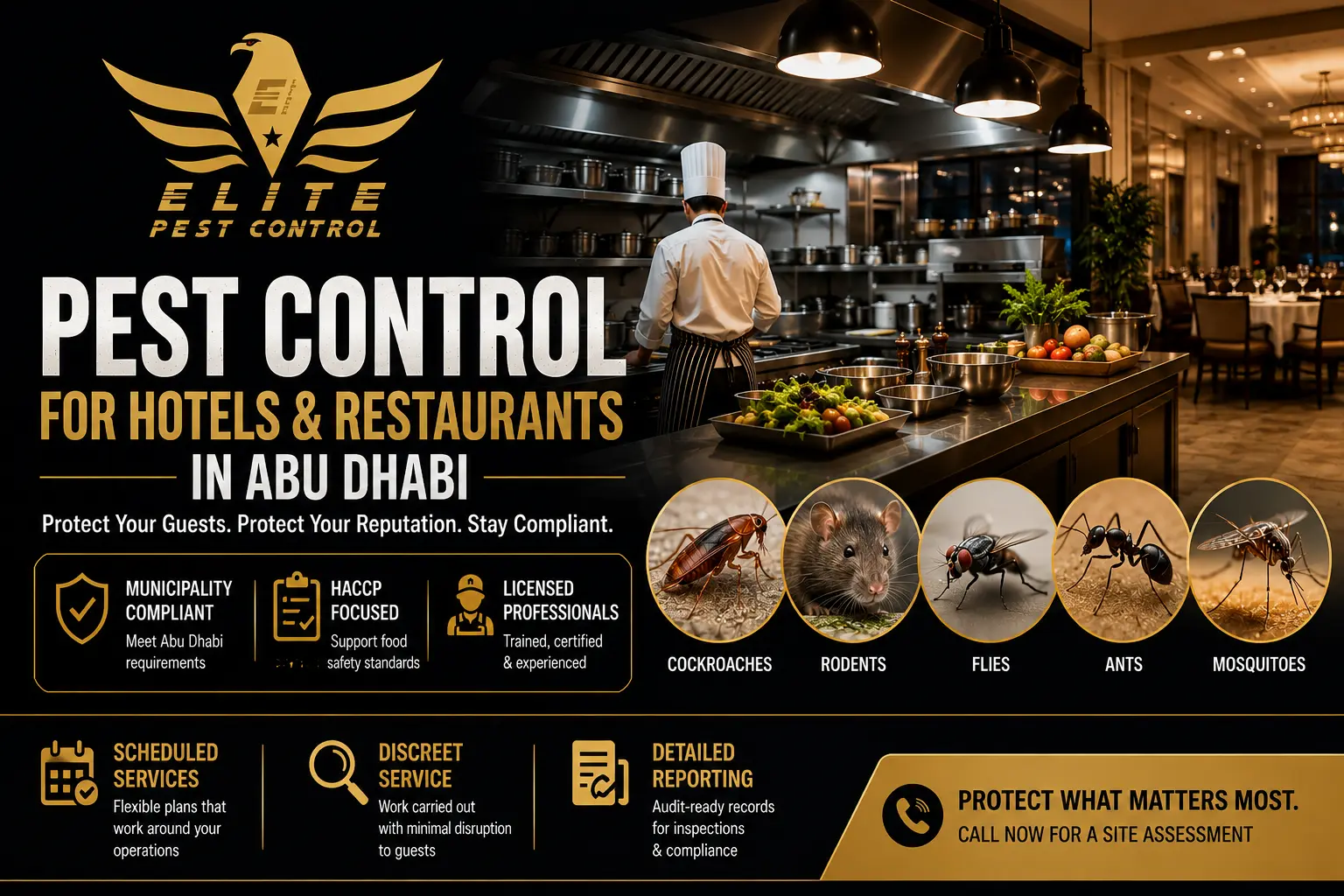
In hospitality, a pest problem is never just a pest problem — it’s a compliance risk, a guest-safety issue, and a reputational threat that can show up in a review before your team even knows there’s an infestation. Pest control for hotels and restaurants in Abu Dhabi requires a different approach than residential treatment: multi-zone properties, guests who can’t be displaced, food-safety audits, and a much lower tolerance for anything going wrong.
This guide covers exactly what hospitality businesses in Abu Dhabi need to know — which pests threaten which parts of your property, what the municipality expects, and how professional treatment actually works around guests and service hours.
Why Hospitality Needs a Different Approach Than Residential Pest Control
A private home can tolerate a missed pest sighting. A hotel or restaurant cannot — because the person who spots the pest isn’t your client, it’s your customer’s customer, and their next move is often a public review rather than a phone call to you.
Three things set hospitality apart from residential pest control:
Guest-facing exposure. Unlike a home, pests in a hotel or restaurant are frequently discovered by someone who has no relationship with the property beyond that single stay or meal — which means the first complaint often arrives publicly, not privately.
Multi-zone complexity. A single hospitality property isn’t one environment — it’s several stacked together: a commercial kitchen, guest rooms or dining areas, outdoor gardens or pool decks, back-of-house storage, and loading docks, each attracting different pests and each requiring a different treatment method.
Regulatory exposure. Hospitality businesses are inspected. A residential pest problem is a private inconvenience; a hospitality pest problem found during a municipality or health inspection can affect licensing, grading, and — for hotels — star-rating compliance.
Abu Dhabi Municipality Requirements and HACCP Compliance
Restaurants, hotel kitchens, and any business serving food in Abu Dhabi fall under municipality food-safety oversight, and pest control is a documented, auditable part of that compliance — not an optional extra. Municipality food-safety inspections expect ongoing, documented pest control as a condition of keeping a trade license in good standing, and HACCP frameworks specifically require pest management as one of the prerequisite programs underpinning food safety — meaning a kitchen can fail a food-safety audit over pest evidence even if every other process is compliant.
Two compliance details are worth knowing before choosing a provider:
- Products must be MOCCAE-registered. Any pesticide used in a licensed pest control operation in the UAE must be registered with the Ministry of Climate Change and Environment — this is what separates a compliant treatment from an informal or unlicensed one, and it’s worth confirming with any provider before signing.
- Technicians and supervisors must be municipally licensed. UAE pest control regulations require a qualified technical supervisor and trained operating staff holding the appropriate health and competency certifications — not just “a company that sprays,” but a properly licensed operation.
What this means practically for hospitality operators:
- Pest control needs to be documented, not just performed — treatment logs, technician visit records, and product-safety data sheets should be available for inspection at any time
- Products used in food-handling areas must be municipality-approved and MOCCAE-registered, which rules out many over-the-counter or DIY treatments entirely
- Inspections can happen with little notice, so reactive, on-demand pest control isn’t sufficient — hospitality properties need a standing, scheduled contract, which is why our pest control frequency guide for Abu Dhabi recommends monthly visits as the standard for restaurants and food-handling businesses, rather than the quarterly cycle that works for most homes
If you’re setting up pest control for a new hospitality property, the documentation trail matters as much as the treatment itself — ask any provider you’re considering how they handle audit-ready reporting and confirm their technicians and chemicals are properly licensed before you ask about pricing.
Pest Risks by Zone
Hospitality properties aren’t one environment — they’re several, and each attracts a different set of pests.
Kitchens and Food Storage
This is the highest-risk zone in any hospitality property, and it’s where most compliance failures originate.
- Cockroaches are the single most common hospitality pest risk — they breed rapidly in the warm, humid conditions typical of commercial kitchens, and a live sighting during a health inspection is one of the fastest routes to a failed audit
- Rodents are drawn to food storage areas, waste zones, and loading docks, and beyond contamination risk, gnaw damage to packaging and even electrical wiring poses a real operational cost
- Ants target food prep surfaces and storage, especially anywhere sugar or starch residue accumulates
- Flies cluster around waste bins, buffet stations, and food service counters, and are a visible, immediate red flag to both guests and inspectors
Guest Rooms and Serviced Apartments
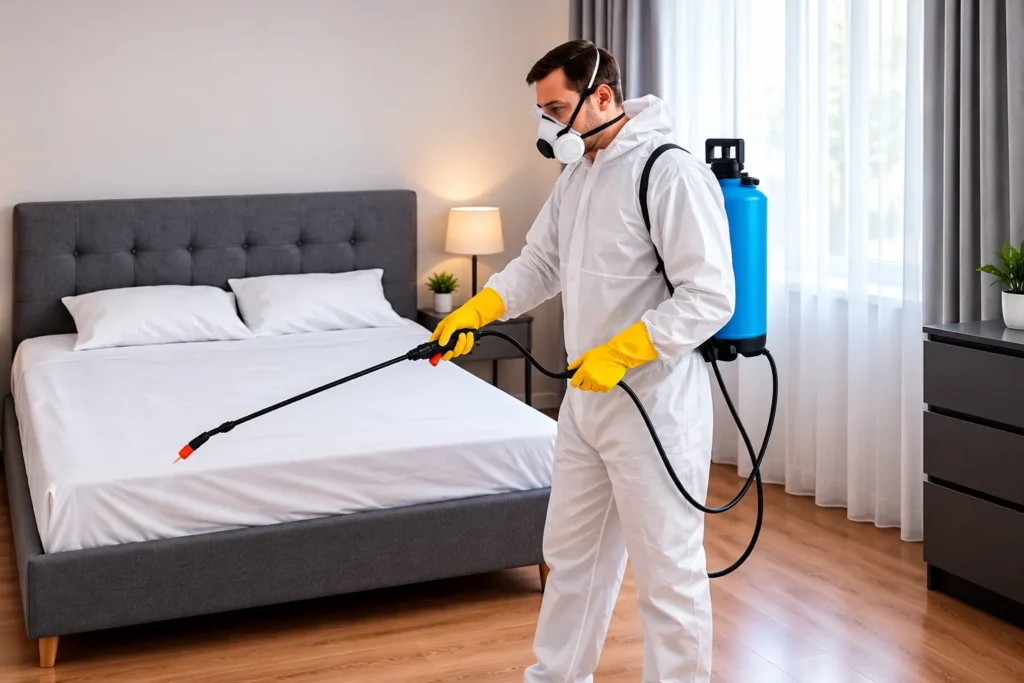
- Bed bugs represent the single biggest reputational risk in hospitality — a bed bug complaint is far more likely to end up in a public review than almost any other pest issue, because guests take photos and post immediately. See our full bed bug identification guide for the early signs housekeeping staff should be trained to spot
- Spiders and lizards turn up more often in ground-floor or garden-facing rooms and, while rarely dangerous, are a common source of guest discomfort complaints
- Silverfish are a frequent, lower-profile issue in linen closets and bathrooms — worth including in routine inspection even though guests rarely report them directly
Pool, Garden, and Outdoor Dining Areas
- Mosquitoes breed in standing water around pools, irrigation systems, and landscaped gardens — a significant concern for resort-style properties with outdoor guest areas
- Bees and wasps are drawn to outdoor dining, poolside bars, and garden event spaces, and pose a genuine safety concern for guests with allergies
- Birds — particularly pigeons — commonly nest on terraces, balconies, and outdoor dining canopies, creating both a hygiene issue and a maintenance cost from droppings on furniture and walkways
Structural and Building-Wide Risk
- Termites are a long-term structural concern for standalone hotel buildings, particularly older properties — damage develops silently over months or years, which is why routine inspection (not just reactive treatment) matters for asset protection
Bed Bugs: Why They Get Special Attention in Hospitality
No other pest carries the same reputational weight in hospitality. A cockroach sighting is bad; a bed bug complaint is often the one guests photograph, name the hotel in, and post publicly within hours.
What makes hospitality bed bug treatment different from residential treatment:
- Speed matters more. A residential bed bug problem can be treated over a reasonable timeline; a hotel room out of inventory is lost revenue every night it’s unavailable, so hospitality treatment prioritizes minimizing room downtime
- Discretion is part of the service. Treatment needs to happen without alarming guests in neighboring rooms or drawing attention in shared corridors
- Staff training adds a prevention layer that pure treatment can’t. Housekeeping staff who know the early signs — small dark spotting on mattress seams, tiny blood spots on linens — can flag a problem before it spreads to adjoining rooms, which is far cheaper than treating a wing of the property after the fact
Operational Constraints Unique to Hospitality
Hospitality pest control has to work around a business that can’t simply pause — which is a genuinely different operational problem than a household treatment.
- Guests can’t be displaced. Treatment scheduling has to work around occupancy, check-in and check-out times, and housekeeping rounds, rather than the property working around the treatment
- Kitchens can’t stop service for extended periods. Food-prep area treatment needs to be timed around service hours, typically early morning or late night, using products safe enough not to require an extended re-entry wait
- Odor and visibility matter. Guest-facing areas need treatments that don’t leave a chemical smell or visible residue in spaces guests will occupy within hours
- Documentation has to happen every visit, not just when requested, since audits can occur with little to no notice
Other Hospitality Businesses We Serve
Hotels and restaurants carry the highest search volume in this space, but the same standards apply across the wider hospitality sector:
- Serviced apartments — the same guest-facing exposure as hotel rooms, often with kitchens attached, combining both risk categories in one unit
- Banquet halls and event venues — typically need a pre-event intensive treatment ahead of large bookings rather than a routine monthly cycle, since these spaces often sit unused between events and then host hundreds of guests at once
- Catering companies and central kitchens — held to the same HACCP standards as restaurant kitchens, often with higher volume and tighter delivery windows
- Cloud kitchens — no dine-in guests, but full commercial kitchen risk, and often located in mixed-use buildings where pest pressure from neighboring units is a real factor
- Bars and lounges — whether standalone or hotel-attached, drink-prep areas and late-hour food service carry similar risk to restaurant kitchens
- Guest houses and hostels — smaller scale than hotels, but the same bed bug and guest-review exposure applies
How Often Should Hospitality Businesses Get Pest Control?
Frequency depends on property type, and it’s covered in full detail in our pest control frequency guide for Abu Dhabi — as a quick summary for hospitality specifically: restaurants and hotel kitchens typically need monthly treatment to maintain HACCP compliance, while guest rooms and non-food areas are often treated on a bi-monthly to quarterly cycle unless there’s active pest activity. Banquet halls and event spaces are usually better served by pre-event treatment than a fixed monthly schedule.
What a Hospitality Pest Control Contract Should Include
Not every contract is built for hospitality’s needs. Before signing, confirm the plan includes:
- Multi-zone coverage in a single contract — kitchen, guest rooms, outdoor areas, and back-of-house treated as one coordinated plan rather than separate bookings
- Priority or same-day emergency response for guest complaints, given how quickly a pest sighting can turn into a review
- Audit-ready documentation provided after every visit, not just on request
- A staff training component, so kitchen and housekeeping teams can flag early signs between scheduled visits
Frequently Asked Questions
Do hotels need monthly pest control in Abu Dhabi?
Hotel kitchens and food-handling areas typically need monthly treatment to stay HACCP-compliant and pass municipality food-safety inspections, similar to standalone restaurants. Guest rooms and non-food areas are often treated less frequently — bi-monthly to quarterly — unless there’s a specific issue like bed bug activity. The right frequency depends on property size, guest turnover, and whether the hotel has on-site dining, so a proper inspection is the most reliable way to confirm the right schedule rather than assuming one blanket frequency across the whole property.
How do you treat bed bugs in a hotel room without closing it for days?
Professional hospitality treatment is built around minimizing room downtime, since every night a room is out of inventory is lost revenue. This typically means using treatment methods with shorter re-entry times than older approaches, treating the affected room and immediately adjoining rooms as a precaution, and scheduling the work during low-occupancy windows where possible. The exact timeline depends on the severity of the infestation, but the goal in hospitality settings is always to return the room to guest-ready status as quickly as safely possible, not simply to treat and wait.
Is pest control treatment safe to use around food service areas?
Yes, when carried out by licensed technicians using municipality-approved products specifically rated for food-handling environments. These products differ from general-use pesticides and are selected to be safe for kitchens, food storage, and dining areas without compromising food safety. Reputable providers will time treatment around service hours and confirm safe re-entry periods before staff resume food prep, and this process should be documented as part of your compliance records, not just performed informally.
What should we do if a guest reports a pest during their stay?
Respond quickly and take it seriously regardless of scale, since guest complaints about pests are far more likely to become public reviews than most other complaints. Move the guest if appropriate, document what was found, and contact your pest control provider for a priority response rather than waiting for the next scheduled visit. Many annual hospitality contracts include emergency call-out provisions specifically for this scenario — confirm this is included in your contract before you need it, not after.
Do serviced apartments need the same pest control as hotels?
Largely yes, since serviced apartments combine the guest-facing exposure of hotel rooms with the food-prep risk of an in-unit kitchen, effectively carrying both risk categories at once. The main difference is scale — a serviced apartment building may have less centralized food service than a hotel restaurant, but individual units with kitchens still need the same food-safe, guest-safe treatment standards applied consistently across every unit.
Get Hospitality-Grade Pest Protection
Whether you’re running a hotel, restaurant, banquet hall, or cloud kitchen, pest control isn’t just about eliminating a problem when it appears — it’s about staying audit-ready, guest-safe, and reputation-protected every day of the year. Book a free hospitality inspection or get in touch with our team to build