
You turn on the tap. The water looks clear. But is it really safe?
In Abu Dhabi, the tap water supply is treated to a high standard before it leaves the mains. But once that water travels into the storage tanks inside your building — your rooftop tank, your underground cistern, your building’s central reservoir — it is entirely separate from the municipal treatment system. From that point on, the quality of your water depends entirely on the cleanliness of your tank.
And in Abu Dhabi’s extreme heat, a water tank that has not been cleaned in six months is not a passive storage vessel. It is an active breeding ground.
This guide answers every question homeowners, landlords, facility managers, and business owners in Abu Dhabi have about water tank cleaning — what it involves, why it matters, how often it must be done, what happens if it is skipped, and how to choose a professional service that actually does the job properly.
What Is Water Tank Cleaning — And Why Is It Not Just “Rinsing the Tank Out”?
Many people assume that water tank cleaning simply means draining the tank, splashing it with water, and refilling it. That is not water tank cleaning. That is water tank rinsing, and it achieves very little.
Professional water tank cleaning is a multi-step process that involves:
Complete drainage. Every drop of stored water is removed from the tank before cleaning begins. Any sediment, sludge, debris, or dead organisms sitting at the bottom of the tank is exposed and accessible.
Physical scrubbing of all internal surfaces. The floor, walls, ceiling (for overhead tanks), and any internal fittings of the tank are manually scrubbed to remove biofilm — the sticky, protective layer that bacteria build on surfaces. Biofilm cannot be removed by water pressure alone. It requires physical agitation, the right cleaning agent, and direct surface contact.
Removal of all sediment, scale, and biological matter. Mineral deposits, rust, algae, and organic debris are vacuumed or manually removed and disposed of.
Chemical disinfection with approved products. After physical cleaning, a biocide — typically a chlorine-based disinfectant — is applied to all internal surfaces. This kills any remaining bacteria, viruses, and pathogens that physical cleaning may not have reached. The disinfectant is left for the required contact time before being flushed out.
Full flush and rinse. The tank is rinsed thoroughly to remove all traces of cleaning chemicals before being refilled with fresh water.
Water quality testing. In a properly managed cleaning process, water samples are taken after refilling to verify that bacterial counts are within safe limits.
Only when all of these steps are completed can you say with confidence that your water tank has been properly cleaned. Anything less is an incomplete job.
Why Is Water Tank Cleaning So Important in Abu Dhabi Specifically?
Abu Dhabi’s environment creates conditions that make water tank contamination significantly more likely — and more dangerous — than in cooler countries. Understanding these factors makes it clear why regular professional cleaning is not optional in the UAE.
The heat accelerates bacterial growth. Bacteria thrive in warm water. In Abu Dhabi, rooftop tanks and poorly insulated tanks regularly reach temperatures of 40–60°C during summer months. At these temperatures, bacteria that would grow slowly in European conditions can multiply to dangerous levels within days. Legionella pneumophila — the bacterium responsible for Legionnaires’ disease — grows most aggressively between 25°C and 45°C, temperatures that Abu Dhabi water tanks reach routinely without any additional heat source.
Intermittent water supply creates stagnation. In some buildings and communities, water delivery schedules mean tanks are not fully refreshed on a daily basis. Stagnant water is a breeding ground for bacteria. The longer water sits in a warm tank without turnover, the more contaminated it becomes.
Dust, sand, and airborne debris. Abu Dhabi’s dusty environment means that improperly sealed tanks — especially older rooftop tanks — are frequently contaminated with airborne particles. Even a small gap around a tank lid allows sand, dust, insects, bird droppings, and other organic matter to enter. This organic material feeds bacterial growth and introduces new pathogens.
Algae growth in light-exposed tanks. Tanks that are not fully opaque, or that have been installed in positions where sunlight penetrates the tank walls, develop algae colonies rapidly. Algae itself is not always harmful, but it creates an environment that supports the growth of harmful bacteria and other organisms.
Scale and mineral deposits. Abu Dhabi’s water has a high mineral content, particularly calcium and magnesium. Over time, scale deposits build up on tank walls and floors. These mineral deposits provide a surface on which bacteria and biofilm anchor themselves, making standard rinsing ineffective.
Insects and pests. Improperly sealed tanks are a frequent entry point for ants, cockroaches, and other insects. If you are also experiencing pest problems in your home or building, there is a real possibility that your water storage system has been compromised. Our pest control services in Abu Dhabi address the wider pest environment around your property, but water tank hygiene must be treated separately.
How Often Should You Clean Your Water Tank in Abu Dhabi?
This is the most common question, and the answer depends on several factors — but there is also a minimum frequency required by UAE regulations.
The UAE standard minimum: every six months.
Abu Dhabi Municipality guidelines require that water storage tanks in residential, commercial, and industrial properties are inspected and cleaned at a minimum frequency of twice per year — once every six months. This is a baseline, not a recommendation for best practice. Many properties benefit from quarterly cleaning.
Residential properties (villas, apartments, townhouses): Every six months at minimum. Properties with large families, high water consumption, or older tanks should consider quarterly cleaning, as higher consumption increases sediment buildup and bacterial loading.
Commercial properties (offices, restaurants, hotels, warehouses): Every three to four months. High-use environments cycle through water faster, but they also have greater health and liability exposure. A water quality incident in a restaurant or hotel has serious regulatory and reputational consequences.
Schools and healthcare facilities: Quarterly cleaning is recommended as standard. Children, elderly individuals, and immunocompromised patients are significantly more vulnerable to waterborne illnesses.
Industrial and manufacturing sites: Every three to six months depending on usage patterns. Sites in Mussafah and other industrial zones must also comply with Tadweer and ADDC requirements.
After construction, renovation, or a long period of vacancy: Any tank that has been out of use or exposed during building works must be cleaned and disinfected before the water supply is reintroduced.
After flooding or contamination events: Immediately. Floodwater carrying soil, sewage, and debris can contaminate tanks quickly, and the risk of illness without treatment is severe.
If you do not know when your water tank was last cleaned, treat it as overdue and schedule a service as soon as possible.
What Are the Warning Signs That Your Water Tank Needs Cleaning?
Do not wait for six months if your water is showing signs of contamination. These warning signs indicate that your tank may already be compromised and needs urgent attention:
Discoloured or cloudy water. Yellowish, brownish, or grey water coming from your taps is a clear sign of sediment or rust contamination. Clear but cloudy water may indicate bacterial growth or suspended particles.
Unpleasant smell. Water with a sulphurous, rotten egg, or musty smell is a strong indicator of bacterial activity inside the tank. Legionella and other bacteria produce gases that create this characteristic odour.
Taste changes. Water that suddenly tastes different — earthy, metallic, or bitter — has likely been contaminated. Do not dismiss taste changes as minor inconveniences.
Visible sediment or particles in water. If you can see particles, flakes, or debris in water poured into a clean glass, your tank is releasing contamination into the supply.
Slime, algae, or deposits on outlets. If you notice slimy residue on tap nozzles, showerheads, or visible pipe outlets, biofilm has developed in your water system.
Increased reports of illness in the household. Gastrointestinal illness, skin irritation, or repeated respiratory infections among household members — especially children — can sometimes be traced to contaminated water. If multiple people in the same building experience similar symptoms, the shared water supply should be investigated.
Evidence of insect or pest activity near the tank. If you notice cockroaches, ants, or other insects near or around your water tank, there is a possibility that the tank seal has been compromised and the water supply has been contaminated by insect activity or droppings. Addressing the pest problem and cleaning the tank must happen together.
What Types of Water Tanks Need Cleaning in Abu Dhabi?
Not all water tanks are the same, and each type presents specific challenges when it comes to cleaning and maintenance. In Abu Dhabi, properties typically have one or more of the following:
Rooftop Overhead Tanks (GRP / Fiberglass Tanks). The most common type in Abu Dhabi residential buildings. These tanks sit on top of the building structure and distribute water via gravity. Because they are exposed to direct sunlight and extreme heat, they are particularly prone to temperature-driven bacterial growth, UV degradation, and algae development. Fiberglass tanks degrade over time, developing cracks and pits on interior surfaces that harbour bacteria. Rooftop tanks also tend to accumulate more dust and debris through lid gaps.
Underground Sumps and Cisterns. Larger underground tanks are common in villas, compounds, and commercial buildings. They are cooler than rooftop tanks but more susceptible to soil contamination if there are structural cracks or inadequate sealing. Sediment accumulation in underground tanks tends to be higher because of slower turnover and gravity settlement.
Building Central Water Reservoirs. Large apartment buildings and commercial towers often have a central ground-level or basement tank that feeds the entire building. These tanks can hold tens of thousands of litres and present a significant risk when not cleaned regularly — because contamination affects every unit in the building simultaneously.
Stainless Steel Tanks. More common in newer commercial installations, stainless steel tanks are more resistant to corrosion but still develop biofilm, scale, and biological contamination without regular cleaning.
Industrial and Agricultural Tanks. Sites in Mussafah Industrial Area and other industrial zones often have large-volume storage tanks for process water and operational use. These require tailored cleaning programmes and compliance with Tadweer and ADDC regulations.
Regardless of type, the cleaning principle is the same: drain, scrub, disinfect, test. The difference lies in access, volume, equipment requirements, and the specific challenges of each tank design.
What Actually Grows Inside a Dirty Water Tank?
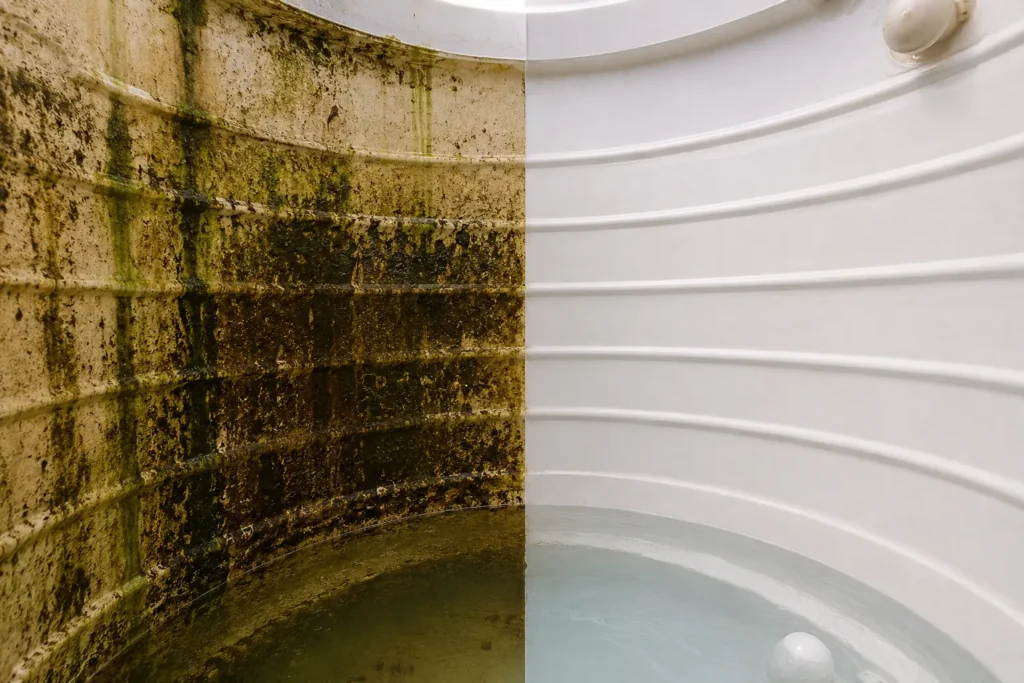
This is the question that makes tank cleaning feel less like a chore and more like an urgent necessity. Here is a detailed breakdown of what builds up inside an uncleaned water tank in Abu Dhabi’s conditions:
Legionella Bacteria (Legionella pneumophila). Legionella is the most dangerous pathogen associated with water tank contamination. It thrives at temperatures between 25°C and 45°C — the range commonly found in Abu Dhabi water tanks. Legionella colonises biofilm on tank walls and is released as fine aerosol droplets when water is sprayed (from showers, taps, and cooling systems). Inhaling these droplets can cause Legionnaires’ disease, a severe and potentially fatal form of pneumonia, as well as Pontiac fever, a milder flu-like illness.
Coliform Bacteria and E. coli. These bacteria enter tanks through contamination from insects, bird droppings, dust, and inadequate sealing. Coliform bacteria cause gastrointestinal illness — nausea, vomiting, diarrhoea, and abdominal cramps. E. coli strains can cause severe illness, particularly in young children, elderly people, and those with compromised immune systems.
Biofilm. Biofilm is not a single organism — it is a self-protecting community of bacteria, algae, and other microorganisms embedded in a sticky matrix attached to surfaces. Biofilm protects bacteria from disinfectants like chlorine, making it extremely difficult to kill without physical removal first. Once established, a biofilm layer becomes a permanent reservoir of contamination unless physically scrubbed away.
Sediment and Sludge. Mineral deposits, rust particles, dead organic matter, and settled debris accumulate at the bottom of tanks over time. This sediment provides nutrients for bacterial growth and can itself carry pathogens. Drinking water drawn from heavily sedimented tanks carries these particles into your household supply.
Algae. In light-exposed tanks, algae colonies develop on the walls and surfaces. While not always directly harmful, algae produces taste and odour compounds, depletes oxygen in the water, and creates an environment that supports bacterial growth. Green or black discolouration inside a tank is usually algae.
Rust and Corrosion Products. In older galvanised or steel tanks, rust particles contaminate the water supply. Elevated iron levels affect taste and can stain laundry, bathrooms, and cooking equipment. Corrosion also creates rough surfaces where bacteria adhere more easily.
Insect Activity and Contamination. Cockroaches, ants, and other insects that find their way into tanks through unsealed lids or pipe openings introduce bacteria from their bodies and droppings. Cockroaches in particular are carriers of Salmonella, E. coli, and multiple other pathogens. If you have a cockroach infestation anywhere in your building, your water tank must be inspected as a matter of priority alongside professional pest treatment.
What Health Risks Come From a Contaminated Water Tank?
The health consequences of drinking from, washing with, or bathing in water from a contaminated tank range from mild to fatal. Understanding this spectrum reinforces why regular cleaning is a genuine health matter, not just a compliance formality.
Gastrointestinal Illness. The most common consequence of drinking bacterially contaminated water is gastrointestinal illness — stomach cramps, nausea, vomiting, and diarrhoea. In healthy adults, this is usually self-limiting. In young children, pregnant women, the elderly, and immunocompromised individuals, severe dehydration from gastroenteritis can require hospitalisation.
Legionnaires’ Disease. This severe pneumonia caused by Legionella bacteria has a fatality rate of 5–10% in otherwise healthy adults and much higher in vulnerable individuals. It is contracted through inhaling contaminated water vapour — from showers being the most common domestic source. Outbreaks in hotels, hospitals, and apartment blocks linked to contaminated water systems are documented events globally and in the region. This is not a theoretical risk.
Typhoid Fever. Salmonella typhi, the bacterium responsible for typhoid, can survive and grow in contaminated water tanks. Typhoid produces a prolonged, severe febrile illness and can cause serious complications without treatment.
Cryptosporidiosis and Giardiasis. These parasitic infections enter water supplies through animal droppings and environmental contamination. Both cause severe gastrointestinal illness. Cryptosporidium is particularly dangerous because it is resistant to chlorine at standard disinfection concentrations — making physical cleaning and removal the primary defence.
Skin and Eye Infections. Bathing or washing with contaminated water can cause skin rashes, eye infections, and ear infections, particularly in children. Pseudomonas aeruginosa, which grows in biofilm on tank surfaces, causes serious skin and ear infections in people with compromised immunity.
Respiratory Problems. Long-term exposure to water contaminated with certain moulds and bacteria through showering and aerosol inhalation can worsen respiratory conditions including asthma. Legionella, as discussed, produces acute respiratory disease.
The most important point is this: most of the time, you will not see, smell, or taste contamination in water from a dirty tank. Bacterial contamination is often invisible. The only way to know your water is safe is to maintain your tank on a regular cleaning schedule.
Can Pests Get Into Your Water Tank — And What Happens When They Do?
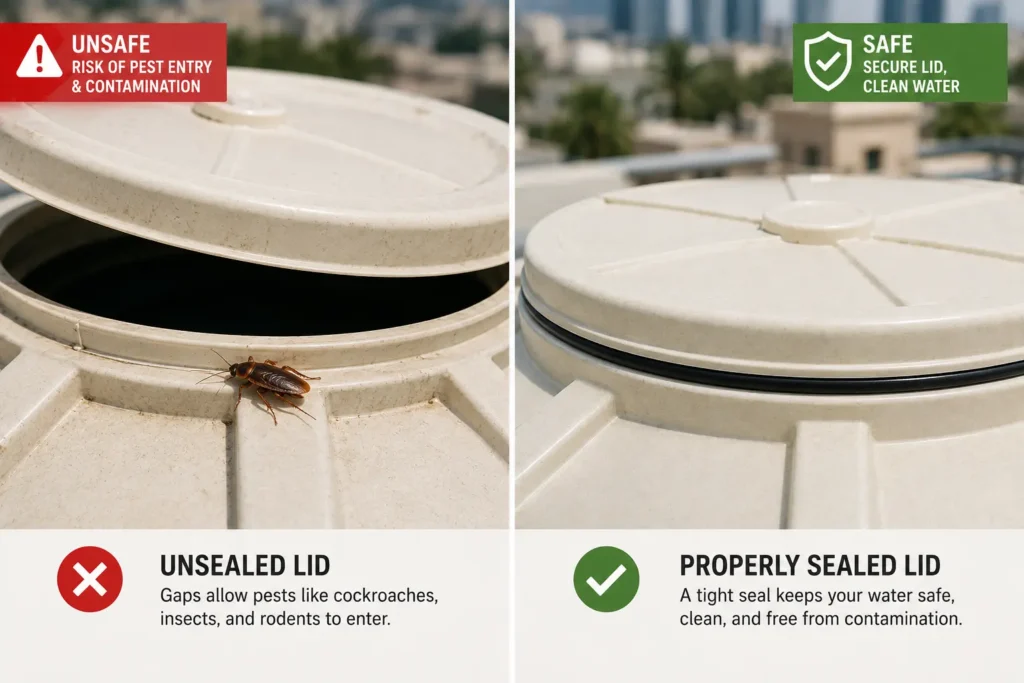
This is a connection that many Abu Dhabi residents have not considered. Your water tank and your pest control situation are directly linked.
How pests enter water tanks. Water tanks in Abu Dhabi properties are frequently found to have inadequate sealing — loose lids, gaps around inlet and outlet pipes, cracked walls, and corroded fittings. These access points are used by insects and rodents in exactly the same way they use gaps in walls and floors to enter your home. Rodents seeking water in the dry summer months will access rooftop tanks through any available opening. Cockroaches following moisture trails will enter through pipe gaps. Even birds nesting near or on uncovered tank access points deposit droppings that contaminate the tank.
What happens to water quality. When pests enter a water tank, they introduce bacteria, viruses, and parasites from their bodies, droppings, and carcasses. A single cockroach in a water tank can contaminate tens of thousands of litres of stored water with Salmonella, E. coli, and Campylobacter. A dead rodent in a tank creates a source of bacterial contamination that continues to leach into the water supply for as long as the body remains.
The dual solution. Addressing water tank contamination caused by pest activity requires both professional water tank cleaning to eliminate the contamination already present, and professional pest control treatment to eliminate the pest population and seal the access routes. Doing one without the other leaves the problem only partially resolved.
If you have noticed pest activity on your roof, in your utility areas, or near water storage systems, contact our team for both pest control services and water tank inspection at the same time. Our technicians can assess both issues during a single site visit.
What Is the Professional Water Tank Cleaning Process — Step by Step?
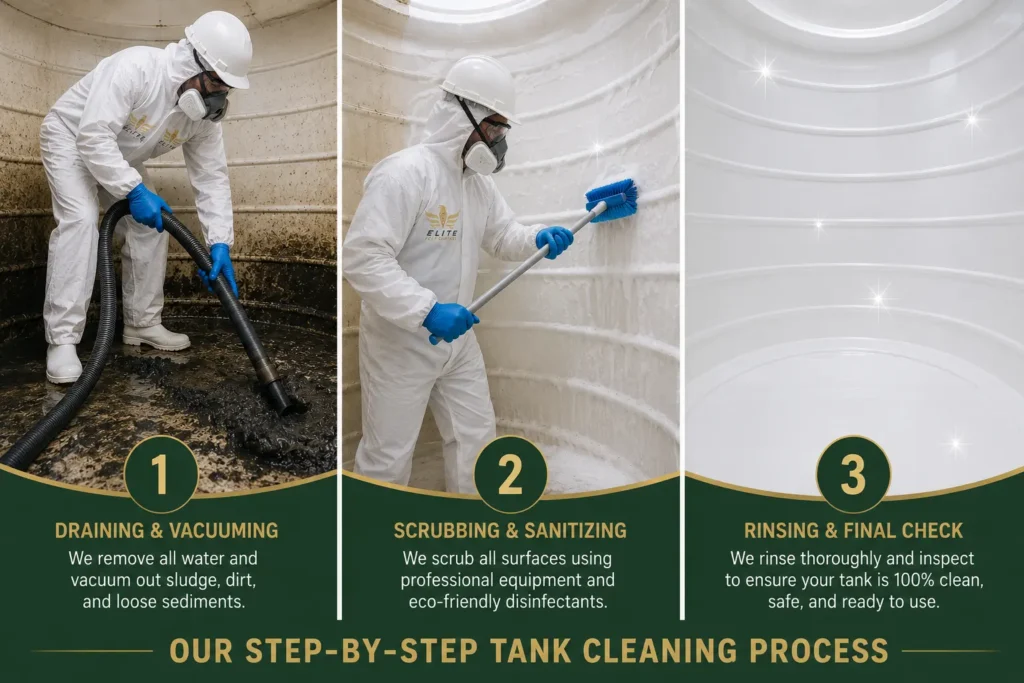
Understanding exactly what a professional cleaning involves helps you verify that a service provider is doing the job properly — and helps you spot shortcuts being taken. Here is the full process as it should be carried out:
Step 1: Pre-Cleaning Inspection. Before anything else, the technician inspects the tank structure. They check for cracks, corrosion, damaged fittings, inadequate seals, signs of biological contamination, and any visible pest activity. The tank type, volume, and access points are assessed to determine the correct cleaning approach and equipment requirements. Any structural defects found are documented and reported to the client.
Step 2: Isolation of the Water Supply. The tank is isolated from the building’s water supply. Inlet valves are closed to prevent fresh water entering during the cleaning process. In buildings with multiple units, this step must be coordinated carefully to minimise disruption.
Step 3: Complete Drainage. The tank is fully drained. For small rooftop tanks this may be as simple as opening the drain valve. For large underground cisterns, submersible pumps are used. Complete drainage is non-negotiable — leaving water in the tank means leaving the sediment layer and the contaminated water that sits above it.
Step 4: Manual Scrubbing of All Internal Surfaces. Technicians — using appropriate personal protective equipment including protective suits, gloves, and respiratory protection — enter the tank or use long-handled equipment to physically scrub every internal surface. The floor, walls, ceiling, and all fittings are scrubbed to remove biofilm, scale, algae, and any visible biological matter. This step is the single most important part of the process. No amount of chemical disinfection can compensate for a tank with intact biofilm.
Step 5: Removal of All Loose Matter. All dislodged sediment, sludge, debris, and biological matter is physically removed from the tank. This is typically done with industrial wet vacuums and manual collection. All removed material is disposed of safely and in compliance with local waste regulations.
Step 6: Application of Approved Disinfectant. A municipality-approved biocidal disinfectant — typically based on sodium hypochlorite (chlorine) at the correct concentration for tank disinfection — is applied to all internal surfaces. The disinfectant is either sprayed or used to fill the tank to a minimum level to ensure full surface contact. The required contact time (typically 30–60 minutes depending on the product and concentration) is observed before the next step.
Step 7: Full Flush and Rinse. After disinfection, the tank is thoroughly rinsed with clean water to remove all traces of cleaning agents and chemical residues. The rinse water is fully drained out.
Step 8: Inspection of Fittings and Seals. Inlet valves, outlet fittings, overflow pipes, and access hatches are inspected. Any gaps or inadequate seals are identified and — where possible within the scope of the service — corrected to prevent re-contamination from pest entry or environmental exposure.
Step 9: Refilling and Water Quality Check. The tank is reconnected to the water supply and refilled. In a complete professional service, a water sample is taken after refilling and submitted for laboratory analysis to confirm that bacterial counts are within safe limits and that no residual disinfectant contaminates the supply. This gives the client documented evidence that the water is safe.
Step 10: Service Report and Certificate. A professional cleaning company provides a written service report documenting the date of service, the technician’s findings, the products used, the cleaning process followed, and the results of any water quality testing. This document is your proof of compliance for Abu Dhabi Municipality inspections.
What Chemicals Are Used to Clean and Disinfect Water Tanks?
Understanding the chemicals used in water tank cleaning helps you verify that a service provider is using approved products correctly:
Sodium Hypochlorite (Chlorine Solution). The most widely used disinfectant for potable water tanks. Applied at the correct concentration (typically 50–100 ppm for contact disinfection), it kills a broad spectrum of bacteria, viruses, and other pathogens. The key requirement is that it is fully flushed out before the tank is put back into service, and that the post-rinse water is tested to confirm no harmful residual levels remain.
Quaternary Ammonium Compounds (QACs). Used in some professional applications as surface biocides. Effective against biofilm and broadly antimicrobial. Must be used at approved concentrations and fully rinsed prior to refilling.
Citric Acid or Descaling Agents. Used specifically to remove mineral scale and calcium carbonate deposits from tank surfaces before disinfection. These are not disinfectants themselves but create a clean surface that allows disinfectants to work effectively.
All products used in water tank cleaning must be approved by Abu Dhabi Municipality and ADDC, and must be appropriate for use in potable water systems. If a cleaning company uses products that are not on the approved list, or uses them at incorrect concentrations, the cleaning is not only potentially ineffective but may also introduce chemical hazards into the water supply. Always ask for the product datasheets and municipal approval references before proceeding.
Can You Clean a Water Tank Yourself, or Do You Need a Professional?
This is an important question and deserves an honest answer. For small, accessible tanks, a property owner with the right products and determination can carry out a basic cleaning. However, there are significant limitations to DIY water tank cleaning in Abu Dhabi:
Access and safety. Rooftop tanks require working at height. Underground tanks are confined spaces. Entry into a confined space without proper training, gas testing, and standby rescue arrangements is extremely dangerous. People die in confined space incidents globally every year — often due to oxygen-depleted atmospheres or toxic gas buildup inside tanks. Professional cleaning companies follow strict confined space entry protocols.
Biofilm removal. Physical scrubbing of all surfaces in a large tank — reaching every corner, every fitting, every rough patch of deteriorated fiberglass — is physically demanding and requires appropriate equipment. Without removing all biofilm, chemical disinfection is largely ineffective.
Correct product concentration. Getting the concentration of sodium hypochlorite right is critical. Too low and it does not disinfect effectively. Too high and residual chlorine contaminates the supply. Measuring and managing chemical concentrations requires knowledge and calibrated equipment.
Water quality verification. Without laboratory water testing post-cleaning, you have no way to verify that the cleaning was effective. Professional services can provide certified test results.
Regulatory compliance. In commercial properties, schools, healthcare facilities, and multi-unit residential buildings, Abu Dhabi regulations require that water tank cleaning is carried out by approved contractors and documented accordingly. DIY cleaning in these settings does not satisfy regulatory requirements.
Our professional recommendation: for small domestic tanks and as a supplementary measure, basic DIY maintenance (checking seals, flushing the tank, checking for visible debris) is worthwhile. For the full cleaning and disinfection that protects your family’s health and satisfies UAE regulatory requirements, a professional service is the right choice.
What Is Water Tank Disinfection — And How Is It Different from Cleaning?
These two terms are often used interchangeably, but they describe different parts of the process:
Cleaning refers to the physical removal of dirt, sediment, scale, biofilm, and biological matter from tank surfaces. Cleaning removes the substrate on which bacteria grow and the protective matrix (biofilm) that shields bacteria from disinfectants.
Disinfection refers to the chemical kill step — applying an approved biocide to destroy any remaining bacteria, viruses, and pathogens on the cleaned surfaces.
The critical point is that disinfection without prior cleaning is largely ineffective. Biofilm protects bacteria from chlorine and other biocides. Studies have shown that bacteria within an intact biofilm can survive chlorine concentrations many times higher than those that kill free-floating bacteria in open water. If you apply disinfectant to an uncleaned tank, you may kill the surface bacteria while leaving the protected biofilm community fully intact and capable of recolonising the tank rapidly once conditions return to normal.
A complete service must include both: thorough physical cleaning first, followed by chemical disinfection, followed by full rinsing.
Some companies offer “tank disinfection” services at a lower price point that skip the physical cleaning step. This is not a compliant or effective service. Always confirm that the service you are booking includes full manual scrubbing before disinfection.
How Long Does Professional Water Tank Cleaning Take?
Time estimates depend on tank size, tank type, degree of contamination, and accessibility:
Small rooftop fiberglass tanks (up to 2,000 litres): Typically 2–4 hours for a complete clean and disinfection including drainage, scrubbing, disinfection contact time, flush, and refill.
Medium tanks (2,000–10,000 litres): Typically 4–8 hours. These tanks often require more thorough scrubbing time and longer disinfection contact.
Large underground cisterns or building central tanks (10,000–50,000 litres): A full professional clean can take 1–2 days depending on the degree of contamination, the number of technicians deployed, and whether significant structural issues need to be addressed.
Industrial tanks (50,000 litres and above): These are project-based engagements that are assessed individually and planned with the client before commencement.
For standard residential properties, the cleaning process is completed within a single day visit. Water supply disruption is typically limited to a few hours for small tanks. For buildings with large central reservoirs, the service can often be scheduled floor by floor or in phases to minimise disruption to residents.
What Happens If You Never Clean Your Water Tank?
The consequences of indefinitely skipping water tank cleaning accumulate over time. Understanding the trajectory helps frame the urgency:
Year one without cleaning. A film of sediment builds at the bottom of the tank. Biofilm begins to establish on tank walls. Chlorine levels in stored water drop as the disinfectant demand from the growing biofilm increases. Water quality begins to decline subtly — detectable by taste and smell tests but not yet posing an acute health risk in most cases.
Year two without cleaning. Biofilm is established across large areas of the tank surface. Sediment layer has thickened significantly. Legionella, if present in the supply, has had the conditions to colonise. In summer months, the risk of Legionella-related illness in the household becomes real. Rust and scale begin to affect water colour.
Year three and beyond without cleaning. Full biofilm communities are present throughout the tank. Sediment may be several centimetres deep. Algae growth is likely if the tank has any light exposure. The tank is now a documented health hazard. Water quality is degraded to the point where regular users are at meaningful risk of illness. Structural deterioration from algae and scale may have begun to affect tank integrity.
Additionally: The longer the tank goes without cleaning, the more difficult and expensive it becomes to clean. Deep-set biofilm requires more aggressive scrubbing. Thick scale requires descaling treatment before cleaning. Structural damage from long-term neglect may require repair or tank replacement. A six-month cleaning schedule is far more cost-effective over the long term than allowing contamination to build to a point requiring remediation.
How Do You Maintain a Water Tank Between Professional Cleanings?
Professional cleaning twice a year is the core of your water tank maintenance plan. Between professional services, there are steps you can take to extend the quality of your water and catch problems early:
Check tank seals and lid monthly. Walk up to your rooftop tank or check your underground tank access point monthly. Look for loose lids, damaged seals, gaps around pipe entries, and evidence of insect or animal activity. Seal any gaps immediately with appropriate filler or sealant.
Inspect for colour and smell quarterly. Fill a clean glass from the nearest tap and check the water against a white background for clarity and colour. Smell the water. Any unusual appearance or odour should prompt you to call for a professional inspection sooner than your scheduled cleaning.
Ensure the tank is adequately insulated. In Abu Dhabi’s climate, reducing the temperature of stored water is one of the most effective measures for slowing bacterial growth. Check that your rooftop tank has proper insulation and UV-resistant cladding, and that it is not sitting in full direct sun exposure without protection.
Avoid topping up contaminated water. If you suspect contamination, do not simply add fresh chlorinated supply water and hope for the best. Fresh supply water mixed with contaminated stored water does not produce clean water. The contaminated tank must be cleaned before refilling.
Keep records. Maintain a log of every cleaning service, including the date, the service provider, and any findings or recommendations. This is both good practice and a regulatory requirement for commercial properties.
Address any pest issues promptly. If you have a cockroach infestation, rodent activity, or ant problem on your property, prioritise resolving it as part of your overall hygiene management — and inspect your water tank as part of that process.
Is Water Tank Cleaning Mandatory Under UAE Law?
Yes. Water tank cleaning in the UAE is not voluntary — it is a legal requirement.
Abu Dhabi Municipality Health Regulations require that all water storage tanks in residential and commercial buildings are cleaned and disinfected at intervals not exceeding six months. Buildings that fail to maintain cleaning records or fail a water quality inspection can receive compliance notices, fines, and in serious cases, orders to halt operations.
ADDC (Abu Dhabi Distribution Company) regulations require that water storage systems connected to the municipal supply are maintained in a condition that does not degrade water quality. Contamination of the municipal supply network through poorly maintained building tanks carries serious legal consequences.
Tadweer and DM regulations for commercial food-handling businesses — restaurants, catering companies, food processing facilities — require HACCP-compliant water management that includes documented water tank cleaning programmes.
For landlords, maintaining clean water storage is part of the habitability obligation to tenants. A tenant who becomes ill as a result of contaminated water from an uncleaned tank has legal recourse against the landlord.
For property management companies and facilities managers, maintaining signed-off cleaning records from approved contractors is the standard of due diligence required. Our professional service provides fully documented service reports that satisfy these requirements.
What Certifications Should a Water Tank Cleaning Company Have in Abu Dhabi?
Not all pest control or cleaning companies are approved to carry out water tank cleaning. When choosing a provider, verify the following:
Abu Dhabi Municipality Approval. The company must hold a current trade licence and be registered as an approved service provider with Abu Dhabi Municipality. For pest-related cleaning services, the company must also hold a valid pest control operator licence.
Tadweer Accreditation (for commercial clients in Mussafah and industrial zones). Tadweer approval is required for waste handling associated with tank cleaning operations in industrial areas.
Trained Technicians with Confined Space Entry Qualifications. Technicians who enter underground tanks must have received formal confined space entry training. Ask whether the company’s technicians hold this certification — it is a safety requirement, not just a credential.
Use of Municipality-Approved Products. All cleaning and disinfection products must be on the Abu Dhabi Municipality approved list for potable water system treatment. Ask for product datasheets and approval references.
Water Quality Testing Capability. A quality service provider can arrange for certified post-cleaning water quality testing. This provides documentary evidence that the cleaning was effective.
How Do You Choose the Right Water Tank Cleaning Service in Abu Dhabi?

With multiple providers in the market, these are the key criteria for selecting a trustworthy and competent service:
Verify regulatory approval first. Before anything else, confirm that the company holds valid Abu Dhabi Municipality approval. This is not a formality — it is your assurance that the company meets minimum standards for equipment, training, and product use.
Ask about the full process. A legitimate professional service should be able to explain, step by step, exactly what they will do. If a company cannot tell you what scrubbing method they use, what disinfectant product they apply, what concentration they use, and how they verify efficacy, move on.
Check for documented service reports. Professional services always provide a written service record. This is your compliance document. Never use a company that provides only a verbal assurance.
Look for combined expertise. Companies that understand both water hygiene and pest control — like Elite Defence — bring a unique advantage to properties where both risks are present. They can assess the whole picture in a single visit rather than requiring multiple separate specialists.
Check reviews and track record. Look for verifiable reviews from other Abu Dhabi clients — particularly commercial clients, landlords, and property managers — who can speak to the quality and professionalism of the service delivered.
Assess responsiveness. A company that responds promptly and provides clear answers during the enquiry process is far more likely to deliver a professional service than one that is hard to reach or vague about what they do.
Why Choose Elite Defence for Water Tank Cleaning in Abu Dhabi?
Elite Defence Pest Control operates as a full hygiene and pest management company across Abu Dhabi. Our water tank cleaning service brings together the same standards of professionalism, municipal compliance, and thoroughness that characterise our pest control work:
Municipality and Tadweer Approved. Our approvals cover both pest control and cleaning operations across Abu Dhabi, giving commercial and residential clients confidence that all work meets the highest regulatory standards.
Fully Trained Technical Team. Our technicians are trained in confined space entry, manual tank cleaning procedures, correct disinfectant application, and water quality verification. We bring the right tools and the right expertise to every job.
Eco-Friendly, Approved Products. All cleaning and disinfection products we use are municipality-approved and safe for potable water systems. We never use products that could introduce chemical hazards into your water supply.
Integrated Pest and Hygiene Management. If pest activity has compromised your water tank, we address both the contamination and the pest infestation in a coordinated programme — something few providers can offer under one roof. From cockroach control and rodent control to ant treatment and bird management, we cover the full spectrum of pest risks that affect water tank hygiene.
Full Documentation. Every tank cleaning is fully documented with a service report, product records, and water quality results where applicable. This is your compliance file, ready for inspection at any time.
Same-Day Service Available. If you discover a water quality problem or a contamination event, we have the capacity to respond the same day across all Abu Dhabi areas.
We Serve All Abu Dhabi Areas. Our cleaning and pest control teams serve Abu Dhabi city, Mussafah, Khalifa City A and B, MBZ City, Baniyas, Shakhbout City, Al Raha, Al Ain, and the Western Region.
Visit our services page for a full list of what we do, or contact us to arrange a free inspection for your property.
Frequently Asked Questions About Water Tank Cleaning in Abu Dhabi
How often should I clean my water tank in Abu Dhabi? The minimum requirement under Abu Dhabi Municipality regulations is every six months. High-use properties, commercial premises, schools, and healthcare facilities benefit from quarterly cleaning. If your tank has never been cleaned or has not been cleaned in over a year, book a service immediately.
What is the difference between cleaning and disinfection? Cleaning is the physical removal of sediment, biofilm, scale, and biological matter. Disinfection is the chemical kill step using an approved biocide. Both are required in every service — disinfection without prior cleaning is ineffective because biofilm protects bacteria from chemical agents.
Can Legionella grow in Abu Dhabi water tanks? Yes. Legionella pneumophila grows most aggressively between 25°C and 45°C — temperatures that Abu Dhabi rooftop tanks regularly reach in summer. Without regular cleaning and temperature management, Legionella colonisation in stored water is a genuine and serious risk.
How do I know if my water tank has contamination? Signs include discoloured or cloudy water, unusual smell or taste, visible sediment in poured water, slime on tap outlets, and unexplained gastrointestinal illness in household members. However, many forms of contamination are invisible — the only reliable way to know is regular professional cleaning and periodic water quality testing.
Is water tank cleaning required by law in Abu Dhabi? Yes. Abu Dhabi Municipality requires water storage tanks to be cleaned at a minimum frequency of every six months. Commercial properties, food businesses, schools, and healthcare facilities face stricter requirements and regulatory inspection.
Do you also handle pest problems around water tanks? Yes. If pest activity has affected your water tank — through insects, rodents, or bird droppings — we provide both water tank cleaning and targeted pest control treatment in a coordinated programme. Our rodent control, cockroach control, ant control, and bird control services address the root cause while we restore your water tank to safe condition.
What areas in Abu Dhabi do you cover for water tank cleaning? We serve the entire Abu Dhabi emirate — Abu Dhabi city, Mussafah, Khalifa City, MBZ, Baniyas, Shakhbout, Al Raha Beach, Al Raha Gardens, Al Ain, and all surrounding areas.
How do I book a water tank cleaning service? Call us on +971 55 906 9032, message us via WhatsApp for the fastest response, or fill in our online form at elitedefencepestcontrol.ae/contact-us-for-pest-free-home. Our team will arrange a convenient time and provide a full breakdown before any work begins.
Book Your Water Tank Cleaning in Abu Dhabi Today
Your water tank is the last point between the municipal supply and your family’s drinking water. Do not leave its condition to chance.
Elite Defence provides professional, municipality-approved water tank cleaning across all of Abu Dhabi — with fully trained technicians, approved products, complete documentation, and same-day availability for urgent cases.
Whether you need a scheduled cleaning for a residential villa, an emergency service for a contaminated commercial tank, or an integrated pest and hygiene programme for a large building, our team has the expertise and approvals to handle it correctly.
Call us now on +971 55 906 9032 or book a free inspection and we will get back to you the same day.
You can also reach us on WhatsApp at +971 55 906 9032 for the fastest response.