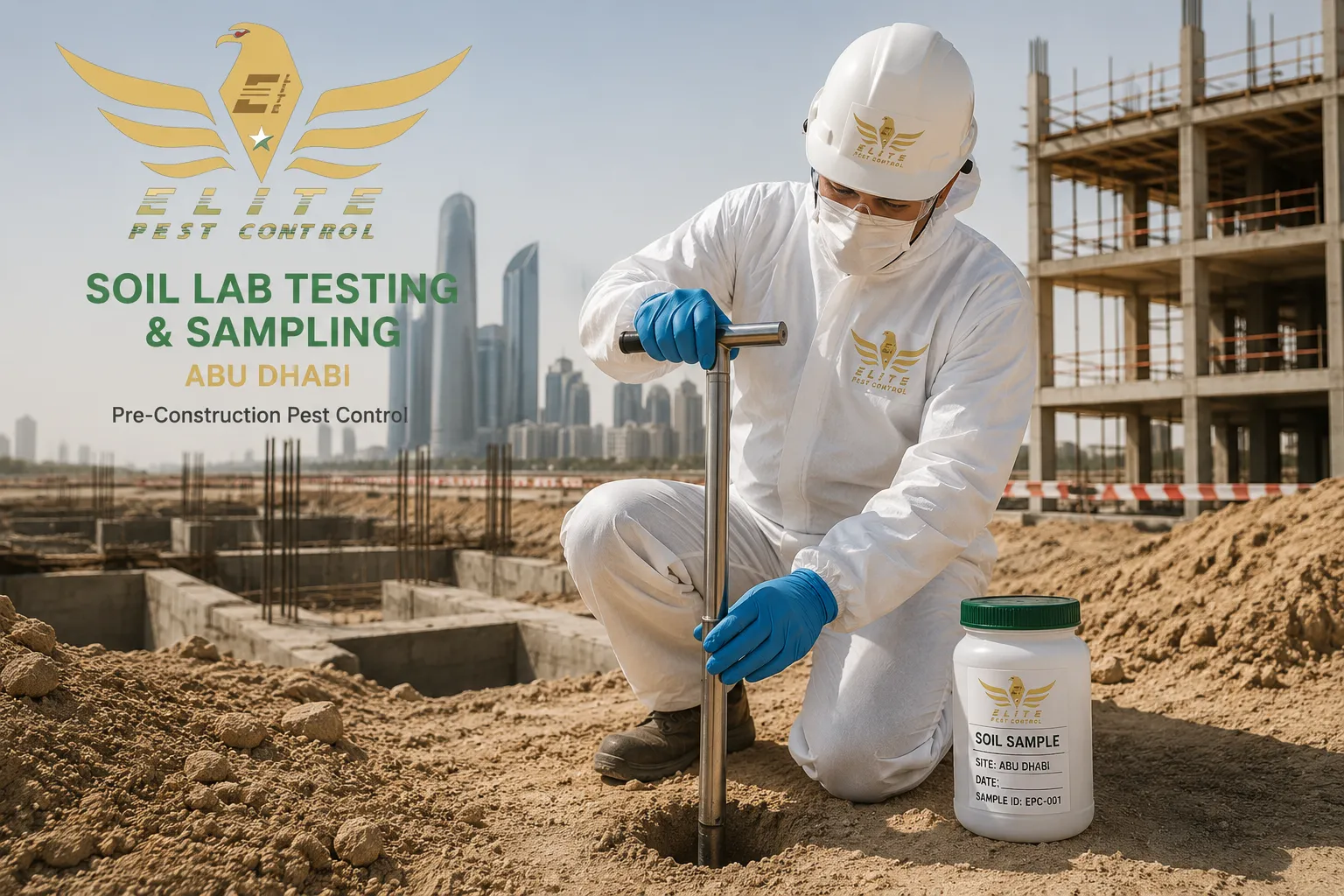
Before a single brick is laid on a construction site in Abu Dhabi, before a garden is landscaped, before a villa extension is planned — the ground beneath your feet needs to be understood. Not just structurally, but biologically and chemically.
Because in Abu Dhabi, the soil is alive with pest risk.
Subterranean termites — the most destructive pest in the UAE — live and breed entirely within the soil. They travel through it invisibly, colonise it silently, and enter your building from it before you ever see a single insect. By the time damage is visible above ground, colonies of millions have been active beneath the surface for months or years.
Soil lab testing and sampling is how that risk is identified, measured, treated, and verified. It is the science behind pre-construction anti-termite treatment, the foundation of post-treatment certification, and one of the most important — yet least understood — pest control services available in Abu Dhabi today.
This complete guide covers everything you need to know: what soil testing involves, why it matters in the UAE, how sampling is carried out, what the results reveal, which treatments are applied, and how Abu Dhabi Municipality regulations require it for new construction.
What Is Soil Lab Testing and Sampling in the Context of Pest Control?
Soil lab testing and sampling in pest control refers to the systematic collection, laboratory analysis, and interpretation of soil samples to assess pest risk — specifically the presence, activity, and conditions that support soil-dwelling pests — and to verify that chemical treatments applied to the soil are effective and correctly concentrated.
It is a technical discipline that sits at the intersection of entomology, soil science, and environmental chemistry, and it underpins some of the most important pest prevention decisions made in the UAE construction and property sector.
In practice, soil sampling for pest control purposes serves three distinct functions:
Risk assessment before construction or treatment. Soil samples collected from a site before building commences are analysed to determine the pest pressure in the ground — the species present, population density, soil moisture levels, pH, organic content, and any existing chemical residues. This information determines whether anti-termite treatment is needed, what product to use, what concentration is required, and how deep the treatment must penetrate.
Treatment verification after chemical application. Once anti-termite or other soil treatments have been applied, samples are taken and tested to confirm that the termiticide has penetrated to the required depth, that concentrations meet the specifications of the treatment plan, and that the protective barrier in the soil is complete and effective. This is the basis on which treatment certificates are issued.
Ongoing monitoring for active properties. Existing buildings can have soil samples collected from around foundations and landscaped areas to detect any evidence of new termite activity or breakdown of existing chemical barriers — providing early warning before an above-ground infestation develops.
Understanding which of these functions you need is the first step in commissioning the right service for your property.
Why Is Soil Testing So Critical in Abu Dhabi’s Construction and Pest Environment?
Abu Dhabi’s environment creates soil conditions that are uniquely favourable to subterranean termites — and that makes soil testing not a precaution but a necessity.
Sandy and loamy soil profiles. Much of Abu Dhabi’s soil is sandy or sandy-loam in composition. These porous soil types allow termites to move freely at significant depths without obstruction. Unlike clay-heavy soils that can physically impede termite movement, Abu Dhabi’s open soil structure provides easy access from deep colonies to building foundations. Soil testing identifies the specific profile so that treatment depths and concentrations are calibrated correctly.
High moisture retention around building foundations. Despite being a desert environment, the soil immediately surrounding buildings in Abu Dhabi accumulates moisture from plumbing, irrigation, air conditioning condensate, and landscaping. Termites need moisture to survive and breed. Irrigation-rich areas — gardens, parks, compound landscaping — consistently show higher termite activity than open desert sites. Soil moisture testing as part of a sampling programme identifies these high-risk zones.
Year-round termite activity. In temperate countries, termite activity slows or stops in cold months. In Abu Dhabi, there is no cold season. Subterranean termites are active 365 days a year, meaning they can colonise soil and attack building foundations without seasonal interruption. The absence of a natural activity break makes pre-construction soil treatment even more critical than in cooler climates.
The scale of construction activity. Abu Dhabi is one of the most construction-active cities in the world. Every new villa, tower, warehouse, and infrastructure project disturbs existing soil — displacing termite colonies and driving them toward adjacent structures. In areas like Mussafah, MBZ, Khalifa City, and new development zones, construction activity consistently elevates termite pressure in surrounding properties. Properties adjacent to active construction sites are at significantly higher risk and benefit particularly from soil sampling and assessment.
Regulatory requirements. Abu Dhabi Municipality requires pre-construction anti-termite soil treatment for all new buildings as a condition of construction approval. Without a valid soil treatment certificate — which is only issued following treatment and post-treatment soil testing — a building permit cannot progress. This is not optional. It is a legal prerequisite to construction.
What Is the Connection Between Soil Conditions and Termite Activity?
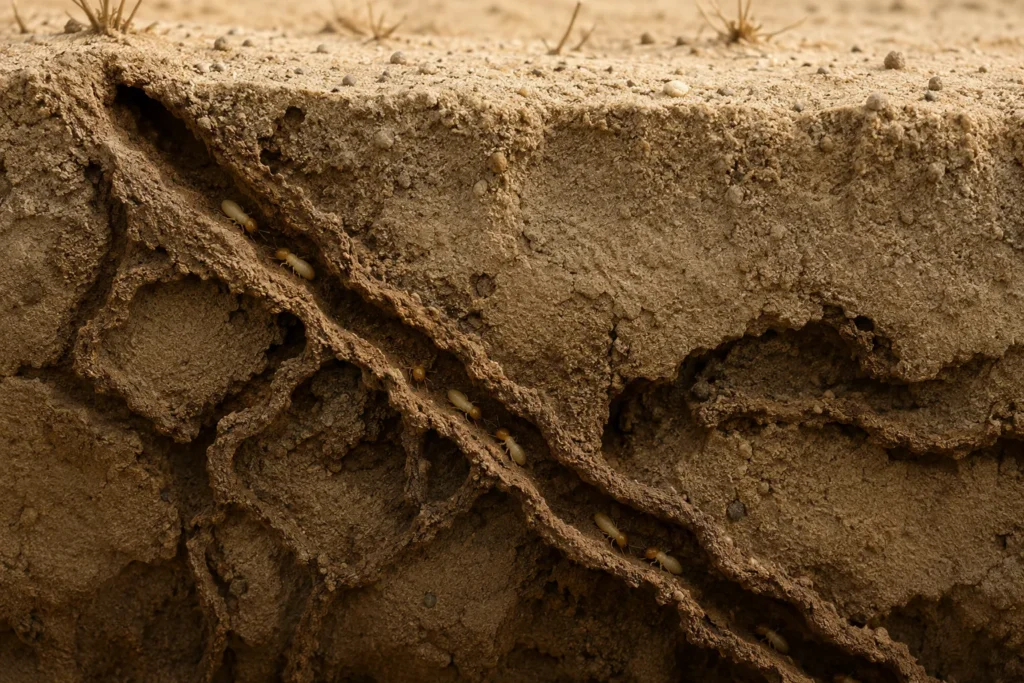
To understand why soil testing matters, you need to understand what termites are looking for in the ground and how soil conditions determine whether your site is high-risk or manageable.
Moisture content. Subterranean termites require soil moisture to survive. They cannot tolerate desiccation and actively seek moist soil zones. Soil moisture levels above approximately 15% by weight consistently support active termite colonies. Areas with drip irrigation, leaking pipes, poor drainage, or high water tables are high-moisture zones — and they are the areas where termite colonies thrive. Soil moisture measurement is a standard component of pre-treatment sampling.
Organic matter content. Termites feed on cellulose — the structural material in wood, paper, cardboard, and plant matter. Soils with higher organic content provide termites with a food source within the ground itself: roots, decaying plant matter, buried timber from construction, and organic debris. Organic content analysis in soil samples helps predict the food resource available to colonies and the likely size of termite populations.
Soil pH. Soil pH affects termite activity indirectly through its influence on the soil microbial community and the effectiveness of chemical treatments. Highly alkaline soils — common in Abu Dhabi’s calcareous desert soils — can affect the longevity and performance of certain termiticide products. pH measurement in soil samples allows treatment planners to select the product most suited to the site’s chemical environment.
Soil texture and particle size. Sandy soils drain quickly and allow chemicals to leach downward — which affects how termiticide concentrations are maintained over time. Clay soils hold moisture but reduce chemical penetration. The soil texture analysis from a sample determines the appropriate application rate and product formulation for effective treatment.
Temperature at depth. Surface temperatures in Abu Dhabi can exceed 50°C in summer, which drives subterranean termites deeper into the soil. Colonies that remain active at 40–80 cm depth may be well below the treatment zone of a poorly planned surface application. Understanding thermal gradients in the soil guides the depth requirements for treatment injection.
Pre-existing chemical residues. In areas previously treated for termites, soil analysis may detect residual termiticide concentrations. This matters for retreatment planning — particularly where older termiticide products, some of which are no longer approved, may still be present in the soil and must be considered when planning new applications.
What Types of Soil Tests Are Carried Out for Pest Control Purposes?
Soil testing for pest control and anti-termite treatment is not a single test. It is a suite of analyses selected based on the purpose of the investigation. Here are the principal tests carried out:
Soil Moisture Content Analysis. Measures the percentage of water in a soil sample relative to its dry weight. This is the most fundamental indicator of termite suitability. High-moisture results identify the zones most at risk of supporting active colonies. Applied to pre-treatment sampling, this test guides where treatment application must be most concentrated.
Soil Organic Matter Content. Organic matter is quantified by loss-on-ignition or chemical oxidation methods. High organic content indicates a food-rich environment for termites and suggests higher treatment intensity is needed.
Soil pH Testing. A straightforward measurement of the hydrogen ion concentration in the soil. Relevant to both termite activity assessment and the selection of termiticide products, since product efficacy varies with soil pH.
Soil Particle Size Analysis (Texture). A grading analysis that determines the proportions of sand, silt, and clay in the sample. This directly determines water retention, chemical penetration rates, and drainage characteristics — all of which affect treatment planning.
Termiticide Concentration Analysis. After anti-termite soil treatment has been applied, soil samples are taken from the treatment zone and analysed to quantify the concentration of the active ingredient present. This verifies that the applied termiticide — most commonly bifenthrin, chlorpyrifos (where still approved), imidacloprid, or fipronil-based products — is present at concentrations that meet the specifications of the treatment standard. This analysis is the foundation of the post-treatment certificate.
Biological Sampling for Termite Presence. Direct sampling of soil using purpose-designed collection tubes, combined with laboratory examination, can detect the presence of live termites, termite eggs, and colony debris within a soil sample. This method is used in risk assessment for existing properties and in monitoring programmes for post-treatment verification.
Pesticide Residue Screening. Broad-spectrum screening of soil samples for the presence of multiple pesticide compounds — used where previous treatment history is unknown and contamination assessment is required, or as part of an environmental management programme for larger sites.
What Is Pre-Construction Anti-Termite Soil Treatment — And Why Is It Mandatory in Abu Dhabi?
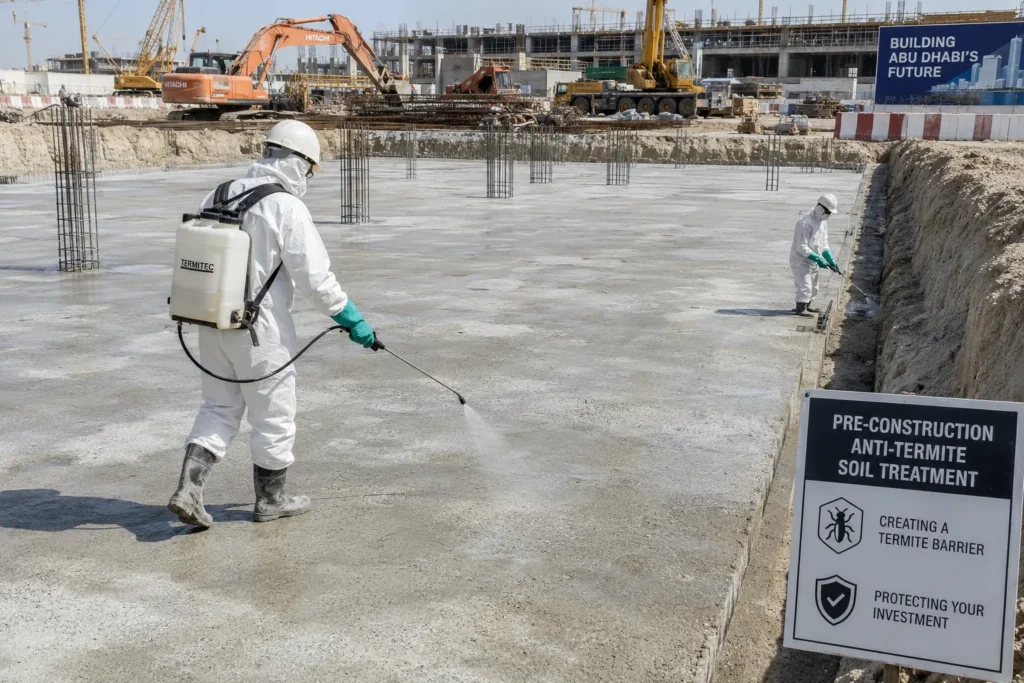
Pre-construction anti-termite soil treatment is the application of a chemical barrier to the soil of a construction site before the building’s foundations, slabs, and walls are laid. Its purpose is to create a toxic zone in the soil beneath and around the future structure that kills or repels subterranean termites before they can make contact with the building’s fabric.
Once a building is constructed, treating the soil beneath it is extremely difficult — it requires drilling through floors and foundations to inject chemicals deep into the soil. Pre-construction treatment, by contrast, allows direct and thorough application to exposed soil before it is covered by concrete, membranes, and structures. It is the single most effective point in the construction timeline to prevent termite entry into a building — and it is the only stage at which full, unobstructed soil treatment is possible.
Why it is mandatory in Abu Dhabi.
Abu Dhabi Municipality and Abu Dhabi Department of Urban Planning and Municipalities (UPM) require that all new residential, commercial, and industrial construction projects undergo certified pre-construction anti-termite soil treatment before construction approvals proceed. The requirement is part of the building code’s provisions for structural protection against pest damage. No construction certificate is issued until a valid soil treatment certificate — issued by an approved pest control operator following treatment and post-treatment soil testing — is submitted to the relevant authority.
For property developers, this means that soil treatment and testing is not an optional extra. It is a prerequisite in the critical path of the project. Delays to soil treatment cause delays to construction. And selecting an approved, qualified pest control operator to carry out the work is not just a quality consideration — it is a regulatory one.
The pre-construction treatment sequence.
The pre-construction soil treatment process follows a specific sequence tied to the construction programme:
Stage 1 — Pre-slab treatment. After excavation and levelling but before the damp-proof membrane and concrete slab are laid, termiticide is applied to the full floor area and sub-base. This treats the soil directly under the slab — the zone from which subterranean termites most commonly enter.
Stage 2 — Perimeter trench treatment. A trench is excavated around the perimeter of the building footprint. Termiticide is applied to the trench base and walls before backfilling. This creates a vertical chemical barrier around the entire foundation perimeter.
Stage 3 — Backfill treatment. As the perimeter trench is backfilled, termiticide is applied to the soil layers as they are replaced — ensuring the barrier continues through the full depth of the foundation zone.
Stage 4 — Post-treatment soil sampling and testing. Samples are collected from the treatment zones and submitted for laboratory analysis. Results confirming adequate termiticide concentrations trigger the issuance of the treatment certificate.
This certificate is then submitted with the construction documentation to Abu Dhabi Municipality as evidence of compliance.
How Does the Soil Sampling Process Work — Step by Step?
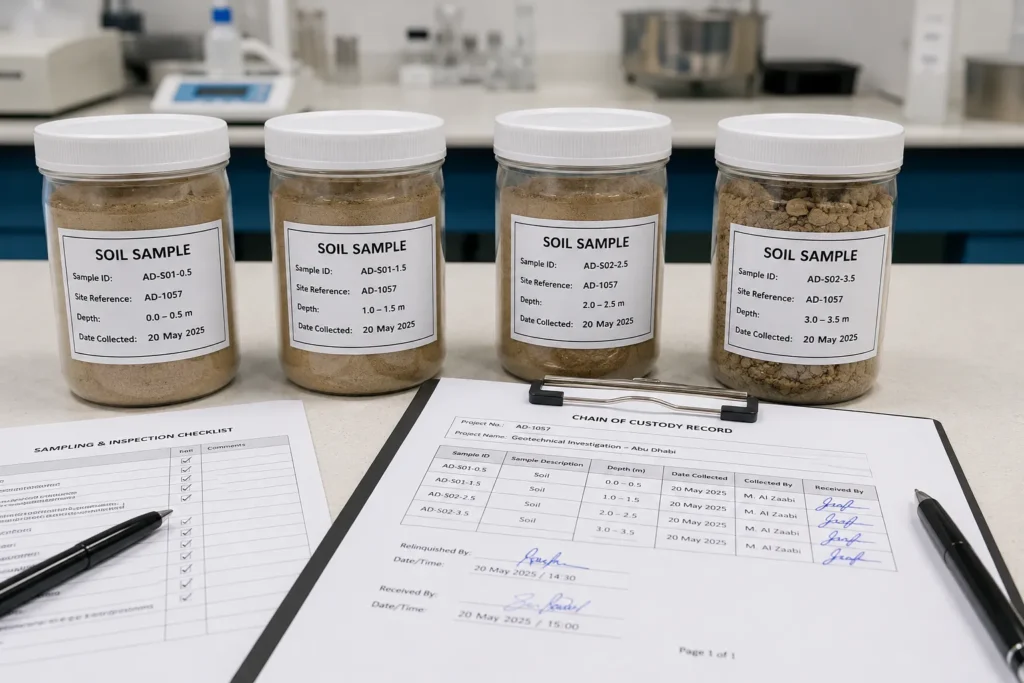
Understanding the sampling process helps you verify that a service provider is conducting a rigorous and compliant investigation. Here is the full process as it should be carried out:
Step 1: Site Assessment and Sampling Plan. Before any samples are collected, the technician assesses the site. For pre-treatment sampling, the site dimensions, soil type, drainage patterns, proximity to water sources, and vegetation are noted. For post-treatment sampling, the treatment zones — floor slab area, perimeter trench, landscaped borders — are mapped and sampling locations are selected to represent all critical zones. A formal sampling plan is documented.
Step 2: Sample Location Selection. Sampling locations are selected at predetermined intervals following a grid or systematic pattern to ensure representative coverage of the site. For pre-construction risk assessment, samples are typically collected at 3–5 metre intervals across the site. For post-treatment verification, samples are collected from within the treatment zones at multiple depths.
Step 3: Collection of Soil Samples. Samples are collected using clean, sterile sampling equipment — either hand augers, split-spoon samplers, or core samplers depending on the required depth. For termite risk assessment, samples are typically collected at 0–15 cm, 15–30 cm, and 30–60 cm depth intervals. For post-treatment verification, samples are collected from within the treatment injection depth — typically 30–50 cm for slab treatment.
Each sample is collected into a labelled, sealed, and tamper-evident container. Sample labelling includes site identification, sample location reference, depth, date and time of collection, and the name of the collecting technician.
Step 4: Chain of Custody Documentation. All samples are accompanied by a chain of custody form from the point of collection through transport to the laboratory. This document records every person who has handled the sample and ensures the integrity of the analytical results. Without proper chain of custody documentation, sample results cannot be relied upon for regulatory purposes.
Step 5: Transport to the Accredited Laboratory. Samples are transported to an accredited analytical laboratory under conditions that preserve the sample integrity. For moisture-sensitive parameters, samples are stored in sealed containers to prevent evaporation. For biological samples, cool storage during transport prevents degradation.
Step 6: Laboratory Analysis. The laboratory carries out the specified analyses on each sample. For post-treatment verification, the primary analysis is termiticide concentration by GC-MS (gas chromatography-mass spectrometry) or HPLC (high-performance liquid chromatography) — quantitative methods that give precise readings of active ingredient concentration.
Results are typically available within 3–7 working days depending on the tests required and the laboratory’s workload.
Step 7: Results Interpretation and Reporting. The pest control professional interprets the laboratory results against the treatment specifications and regulatory standards. A formal written report is produced documenting the sampling locations, methods, laboratory results, interpretation, and conclusion — specifically, whether the treatment meets the required standard for certificate issuance.
Step 8: Certificate Issuance. Where results confirm that all treatment zones meet the required termiticide concentration specifications, the approved pest control operator issues the soil treatment certificate. This document is submitted to Abu Dhabi Municipality as part of the construction compliance file.
What Soil Properties Make a Property High-Risk for Termite Infestation in Abu Dhabi?
Not all sites carry equal termite risk. Soil testing reveals which properties face the highest pressure from subterranean termites, enabling proportionate treatment responses. These are the soil characteristics that most significantly elevate risk:
High moisture zones near foundations. As discussed, moisture is the primary environmental requirement for subterranean termite survival. Properties with consistently moist soil around foundations — due to irrigation systems, leaking pipes, drainage issues, or high water tables — consistently attract and support larger termite colonies. Soil moisture readings above 20% at foundation depth are a high-risk indicator.
Sandy soil with low clay content. Sandy soils are physically easy for termites to tunnel through and drain quickly — reducing the longevity of water-based termiticide formulations. Sites with predominantly sandy soil require higher-concentration or longer-residual treatment products.
High organic matter near structure. Buried timber (from temporary formwork, tree stumps, roots), cardboard packaging left in backfill, and organic-rich imported topsoil provide food sources that draw termite colonies toward the building zone. Organic matter content above 3% in sub-foundation soils is a risk factor.
Calcareous or alkaline soil. Much of Abu Dhabi’s natural soil is calcareous — high in calcium carbonate, producing alkaline pH readings of 7.5–8.5 or higher. Alkaline soil can reduce the efficacy of certain termiticide formulations and accelerates the breakdown of some products. Soil pH testing guides product selection to ensure the chosen termiticide maintains its efficacy in the specific site chemistry.
Proximity to established green spaces or irrigation. Properties near parks, golf courses, mature gardens, or heavily irrigated compound landscaping are exposed to high termite pressure from established colonies in the surrounding soil. This pressure is permanent and ongoing — making both pre-construction treatment and periodic post-construction monitoring essential.
Previous construction activity nearby. As noted, construction activity displaces existing termite colonies. Sites adjacent to demolition, excavation, or ongoing construction consistently show elevated termite pressure as displaced colonies seek new structures.
What Happens After Soil Sampling — What Does the Lab Actually Test For?
Once samples arrive at the laboratory, the specific analyses depend on the purpose of the sampling. Here is what each key parameter involves:
Termiticide Residue Quantification. The most critical test for post-treatment verification. Using GC-MS or HPLC techniques, the laboratory precisely measures the concentration of the termiticide’s active ingredient in the soil sample. Results are expressed as milligrams of active ingredient per kilogram of soil (mg/kg). These results are compared against the minimum effective concentration specified in the treatment plan and the regulatory standard. For bifenthrin-based treatments, for example, the required minimum post-treatment concentration is specified by the product registration and must be present at the specified treatment depths.
Soil Moisture by Gravimetric Method. The sample is weighed wet, dried in an oven at 105°C until constant weight is achieved, and reweighed. The difference expressed as a percentage of dry weight is the moisture content. This gives a precise quantification of the moisture environment at the time of sampling.
Organic Matter by Loss on Ignition. The dried soil sample is heated to 550°C in a furnace. The weight loss represents the organic fraction. This gives the organic matter percentage.
Particle Size Analysis. Using sieve analysis and hydrometer methods, the laboratory determines the percentage distribution of gravel, coarse sand, fine sand, silt, and clay fractions. This gives the soil textural class — sandy loam, silty clay, clayey sand, and so on.
pH and Electrical Conductivity. pH is measured in a soil-water suspension. Electrical conductivity (EC) indicates salinity — important in coastal Abu Dhabi soils where high salinity affects both chemical performance and plant-soil-pest interactions.
Biological Examination for Termite Evidence. Laboratory examination of biological samples may identify termite body fragments, eggs, frass (termite excrement), and fungal garden material characteristic of termite colony activity. This provides direct biological evidence of colony presence in the sampled area.
Can Existing Properties Benefit from Soil Testing — Or Is It Only for New Construction?
Soil testing is not exclusively a pre-construction activity. Existing residential and commercial properties in Abu Dhabi benefit significantly from periodic soil assessment, particularly:
Properties with active or suspected termite infestations. If you are seeing signs of termite activity — mud tubes on walls, hollow-sounding timber, discarded wings near windows, or damaged wood — soil sampling around the building’s perimeter and at entry points provides crucial information about the extent of the ground-level infestation. It guides the treatment approach and the injection points for remedial soil treatment. Our termite control services include full property assessment including soil evaluation.
Properties where the original treatment certificate is aged or unavailable. Abu Dhabi’s pre-construction treatment requirement has been in place for many years, but older properties may have been built before the requirement, or treatment records may be lost. For these properties, soil sampling establishes the current chemical residue levels in the soil — confirming whether any residual barrier remains or whether the soil is now unprotected.
Properties after major landscaping or garden renovation. Significant landscaping work — excavating for new planting beds, installing irrigation systems, importing topsoil — can disrupt or dilute existing chemical barriers in the soil. Post-renovation soil testing confirms whether the barrier has been compromised and whether retreatment is needed.
Properties in high-risk zones near construction activity. As noted, properties adjacent to demolition or excavation should have soil sampling carried out to detect any new colony migration into the site.
Commercial properties, hotels, and compounds. For properties with ongoing maintenance contracts, periodic soil testing around the perimeter provides documented evidence of ongoing protection — important for insurance, regulatory compliance, and building management due diligence.
How Does Soil Testing Connect to Garden, Landscape, and Agricultural Pest Control?
Beyond termites and construction, soil testing in Abu Dhabi’s context connects to landscape management and the broader pest pressures affecting gardens, parks, and agricultural plots. Understanding the soil environment helps predict and prevent a wider range of pest problems:
Soil-Borne Insect Pests in Gardens. Several landscape and garden pest species in Abu Dhabi are soil-dwelling at some stage of their lifecycle. White grubs (larvae of various beetle species), cutworms, wireworms, and various root-feeding nematodes live and breed in the soil before causing above-ground damage to plants. Soil sampling in garden and landscaped areas can detect larval populations before they emerge and devastate planted areas.
Ants and Soil Structure. Many ant species that cause problems in Abu Dhabi properties — including fire ants, black garden ants, and pavement ants — nest in soil and create extensive underground colonies. Soil sampling can identify nest locations and colony density, guiding targeted treatment. Understanding soil structure also helps explain why certain areas of a garden consistently harbour ant activity — sandy, well-drained soil is particularly attractive for ant nesting.
Mosquito Breeding and Soil Drainage. Poorly draining soil creates surface water pooling — one of the primary conditions driving mosquito breeding in residential areas. Soil permeability testing identifies drainage problem zones, which can be addressed through both soil improvement and targeted mosquito treatment.
Pesticide Management in Agricultural Settings. For properties with fruit trees, vegetable gardens, or small-scale agricultural plots — common in compound villas and farm properties in Abu Dhabi’s outskirts — soil testing ensures that pesticide applications are not accumulating to levels that affect soil health, contaminate irrigation water, or create residue concerns in food crops.
Soil Improvement for Reduced Pest Pressure. Healthy, well-balanced soil supports robust plant growth — and healthy plants are more resistant to pest attack. Soil testing for pH, nutrients, and organic content in garden and agricultural settings guides soil improvement programmes that reduce overall pest vulnerability.
What Other Soil-Borne Pests Are Detected Through Soil Sampling in the UAE?
While subterranean termites are the primary focus of soil pest sampling in Abu Dhabi, they are not the only soil-associated pest of concern:
Subterranean Ants. As noted, numerous ant species in the UAE build extensive underground nests. Soil sampling in problem areas can locate nest systems and guide treatment application. Our ant control service addresses both above-ground activity and underground colony treatment.
Rodents (Rats and Mice). Rodents in Abu Dhabi frequently nest in soil — particularly in uncompacted ground, around irrigation systems, and in areas with ground-level vegetation. Soil sampling in a pest context can identify burrowing activity, and soil-based rodenticide placement is a standard component of rodent management programmes. Our rodent control service includes assessment of soil-based harbourage and nesting sites.
Biting Midges and Soil-Breeding Flies. Certain species of biting midge and small fly breed in moist organic-rich soil. Properties with decomposing organic matter in garden soil — particularly near composting areas or poorly managed landscaping — can experience infestations of these pests that originate from soil-level breeding sites.
Soil-Dwelling Cockroach Species. Certain cockroach species in the UAE — particularly Oriental cockroaches — can be found in moist soil around foundation areas and in crawl spaces. Regular perimeter cockroach control treatment overlaps with the soil environment around structures.
Nematodes and Plant Root Pests. Root-knot nematodes and other soil-dwelling plant parasites cause significant damage to garden plants and street trees in Abu Dhabi. Soil sampling for nematode populations is part of a complete landscape pest management programme.
Is Soil Treatment and Certification Required by Abu Dhabi Municipality Before Construction?
Yes, and the requirement is clearly established. Here is the regulatory framework governing soil treatment and certification for new construction in Abu Dhabi:
Abu Dhabi Urban Planning Council and Municipal Authority Requirements. All new construction projects — residential villas, apartment buildings, commercial towers, warehouses, and infrastructure works — are required to submit a valid pre-construction anti-termite treatment certificate before construction permits are finalised. This is reviewed as part of the technical documentation submitted to the municipality.
Approved Contractor Requirement. The treatment must be carried out by a pest control company holding a valid licence from Abu Dhabi Municipality and approved as a pest control operator. Treatment certificates issued by unlicensed or unapproved operators are not accepted. Elite Defence Pest Control holds full municipality and Tadweer approvals — making our certificates valid for submission to Abu Dhabi Municipality and all relevant project approval authorities.
Treatment Standards. The treatment must be carried out in accordance with the specifications set out in the applicable municipal standard. This includes the minimum termiticide concentration required, the application zones (slab area, perimeter trench, backfill), the required treatment depths, and the post-treatment verification testing requirements.
Certificate Validity. Pre-construction soil treatment certificates in Abu Dhabi are typically valid for a defined period from the date of treatment. If construction is delayed significantly beyond this validity period, retreatment and recertification may be required before the certificate can be used for permit purposes.
Compliance Inspections. Abu Dhabi Municipality inspectors may visit construction sites to verify that soil treatment has been carried out correctly before allowing the concrete slab to be poured. Physical inspection of the treatment application — checking that the full floor area and perimeter trenches have been treated — is part of the compliance verification process.
For property developers, project managers, and contractors: do not leave soil treatment to the last minute. It must be planned into the construction schedule at the foundation stage, and the certificate must be in hand before the municipality inspector clears the slab. Early engagement with an approved pest control operator ensures this critical path item does not become a project delay.
What Documents Are Issued After Professional Soil Treatment and Testing?
A complete and compliant soil treatment and testing programme for construction purposes produces a specific set of documents that must be maintained as part of the project compliance file:
Soil Treatment Certificate. The primary regulatory document. Issued by the approved pest control operator, it confirms that pre-construction anti-termite soil treatment has been carried out in accordance with the applicable Abu Dhabi standard. It includes: the property address and plot reference, the date of treatment, the product(s) used with registration details, the application zones and depths treated, the technician’s name and qualification, and the operator’s licence number and municipal approval reference.
Treatment Application Record. A detailed technical record of the treatment application — volumes applied per zone, concentrations used, equipment used, weather conditions at time of application, and any site-specific observations. This document supports the certificate and provides evidence that the treatment was carried out as specified.
Post-Treatment Laboratory Report. The accredited laboratory’s analytical report detailing the sample collection locations, sampling depths, analytical methods used, and quantitative results for termiticide concentration and any other parameters tested. This report is the scientific evidence underpinning the certificate.
Chain of Custody Records. Documentation of sample handling from collection through transport to the laboratory, ensuring the integrity of the analytical results.
Site Sampling Plan and Map. A scaled drawing of the site showing the sample collection locations and the treatment zones. This enables a third party — such as a municipality inspector — to verify that sampling was carried out at the correct locations and intervals.
Keep all of these documents together in your construction compliance file. They may be requested by Abu Dhabi Municipality, by insurance companies, by future property buyers, or by legal advisors if questions about building protection arise in the future.
How Do You Choose a Reliable Soil Testing and Treatment Company in Abu Dhabi?
With multiple companies offering soil treatment services in Abu Dhabi, these criteria distinguish a professional, compliant operator from one that cuts corners:
Current Abu Dhabi Municipality Approval. This is non-negotiable. Ask for the operator’s pest control licence number and verify it is current. An expired or absent licence means the certificate they issue will not be accepted by the municipality.
Laboratory Accreditation. The laboratory analysing your soil samples must hold accreditation from a recognised body — in the UAE context, Emirates National Accreditation System (ENAS) accreditation is the standard. Unaccredited laboratories may produce results that are not accepted for regulatory purposes.
Clear Post-Treatment Testing Included. A complete soil treatment service always includes post-treatment sampling and laboratory testing. If a company offers treatment but no post-treatment verification, the certificate they issue is not supported by data — and it may not be accepted. Always confirm that laboratory analysis is included in the scope.
Product Transparency. Ask which termiticide products are used and request the product registration details. All products used in Abu Dhabi must be registered with the relevant UAE authority. Non-registered products are not only potentially ineffective but their use in UAE is not compliant.
Full Documentation Package. Confirm that the service includes all required documents: treatment certificate, application record, laboratory report, chain of custody forms, and site map. If a company is reluctant to commit to full documentation, that is a warning sign.
Experience with Municipality Submissions. An operator who has experience submitting soil treatment certificates to Abu Dhabi Municipality will understand the specific format and content requirements that the authority expects. This saves time and avoids resubmission delays.
Integrated Pest Management Capability. A company that offers both soil treatment and broader pest management services — including termite control, ant management, and rodent control — brings valuable context to soil pest assessment. They can identify multiple pest risks in a single site visit rather than requiring separate engagements.
Why Choose Elite Defence for Soil Lab Testing and Anti-Termite Treatment in Abu Dhabi?
Elite Defence Pest Control brings together municipality approval, technical expertise, and comprehensive service delivery to make soil testing and pre-construction treatment as straightforward as possible for developers, contractors, and property owners across Abu Dhabi.
Municipality and Tadweer Approved. Our approvals cover both pest control operations and pre-construction soil treatment in Abu Dhabi. Treatment certificates issued by Elite Defence are valid for submission to Abu Dhabi Municipality and all relevant approval authorities.
Experienced Across All Construction Scales. From single-plot villa developments in Khalifa City to large multi-unit residential and commercial projects in Mussafah and MBZ, our team has handled pre-construction soil treatment programmes across all property types. We understand the construction timeline pressures and work to ensure soil treatment does not become a critical path delay.
Accredited Laboratory Partnership. All post-treatment soil samples are submitted to accredited laboratories. Results are provided in a format that meets Abu Dhabi Municipality requirements and supports certificate issuance.
Complete Documentation Package. Every soil treatment engagement with Elite Defence produces the full documentation set — treatment certificate, application records, laboratory report, chain of custody, and site map — ready for submission or retention in your compliance file.
Expert Termite Control Beyond the Certificate. Soil treatment is the first line of defence. If termite activity is detected in an existing property, our termite control service provides comprehensive remedial treatment — including soil injection, baiting systems, and structural treatment — backed by the same municipal approvals and technical expertise.
Integrated Pest Programme Available. Soil treatment naturally connects to broader pest management needs. Our ant control, rodent control, cockroach control, and full suite of pest control services can be delivered under a single ongoing maintenance contract — giving your property comprehensive protection from ground level upward.
Same-Day Response for Urgent Cases. Construction timelines do not wait. If you need rapid soil treatment and sampling to meet an inspection deadline, our team is available for same-day and next-day mobilisation across all Abu Dhabi areas.
Areas We Serve. Abu Dhabi City and Corniche, Mussafah Industrial Area, Khalifa City A and B, Mohammed Bin Zayed City (MBZ), Baniyas, Shakhbout City, Al Raha, Al Ain, and the entire Abu Dhabi emirate.
Visit our About Us page to learn more about our certifications and team, or browse our full services list for a complete picture of how Elite Defence protects properties across Abu Dhabi.
Frequently Asked Questions About Soil Lab Testing and Sampling in Abu Dhabi
Is pre-construction soil treatment for termites mandatory in Abu Dhabi? Yes. Abu Dhabi Municipality requires a valid pre-construction anti-termite soil treatment certificate for all new construction projects before permits are finalised. The certificate must be issued by a municipality-approved pest control operator following treatment and post-treatment laboratory testing.
What termiticide products are used in soil treatment in Abu Dhabi? Commonly used products include bifenthrin-based termiticides, imidacloprid formulations, and fipronil-based products — all registered and approved for use in the UAE. The product selection depends on the soil type, pH, organic content, and moisture profile of the specific site. Elite Defence uses only UAE-registered, municipality-approved products.
How deep are soil samples taken during post-treatment testing? Typically at 0–15 cm, 15–30 cm, and 30–50 cm depth intervals within the treatment zones. The specific depths correspond to the application zones specified in the treatment plan — typically the under-slab zone and the perimeter trench depth.
How long is a soil treatment certificate valid in Abu Dhabi? Validity periods vary depending on the product used and the municipal standard applicable at the time of treatment. Typically, certificates are valid for 5–10 years from the date of treatment for the product types most commonly used in Abu Dhabi. If construction is significantly delayed, check with your approved operator whether the certificate remains valid or whether retreatment is needed.
Can an existing property get a soil treatment certificate if it never had one? Yes. Post-construction soil treatment around foundations, with subsequent soil sampling and laboratory verification, can produce a treatment certificate for an existing property. This process is more complex than pre-construction treatment but is achievable and may be required for insurance, resale, or compliance purposes.
What is the difference between soil sampling for termites and a standard termite inspection? A standard termite inspection is a visual and physical inspection of accessible building areas for evidence of above-ground termite activity. Soil sampling is a technical field and laboratory process that assesses the sub-surface soil environment — detecting colony activity below ground, measuring chemical treatment residues, and characterising soil conditions. Both are part of a comprehensive termite assessment programme.
Do you carry out soil testing for garden and landscape pest problems as well as construction? Yes. Soil sampling for garden pest assessment — including soil-dwelling insects, nematodes, ant colony location, and pesticide residue management — is part of our service offering for residential villa gardens, compound landscapes, and agricultural plots.
How do I book a soil treatment and sampling service? Call us on +971 55 906 9032, message via WhatsApp, or complete the enquiry form at elitedefencepestcontrol.ae/contact-us-for-pest-free-home. We will arrange a site visit, provide a full proposal, and confirm our availability to meet your construction timeline.
Book Your Soil Lab Testing and Anti-Termite Treatment in Abu Dhabi Today
Whether you are a developer preparing for construction, a contractor facing a municipality inspection deadline, or a property owner concerned about termite activity in the ground around your building — Elite Defence provides the soil testing, treatment, and certification service you need.
Municipality approved. Fully documented. Same-day availability for urgent cases.
Call us on +971 55 906 9032 or request a free site assessment and our technical team will respond the same day.
You can also reach us instantly via WhatsApp at +971 55 906 9032.
Elite Defence Pest Control LLC — Office No. 18, Plot No 161, Al Jazzeem Building, Street 9, Musaffah M-37, Abu Dhabi, UAE. Municipality and Tadweer Approved. Safe • Reliable • Pest-Free Living.