Do Bird Spikes Work on Pigeons? Pros, Cons and Rules for Abu Dhabi Homes
By Elite Defence Pest Control, Musaffah, Abu Dhabi · Published 6 November 2026 · Last updated 6 November 2026 · 8 min read
Who this is from: Elite Defence Pest Control is a municipality-approved pest control company in Musaffah M-37, Abu Dhabi. Why we wrote it: to give you a straight answer on bird spikes before you spend money on the wrong fix.
Short answer: bird spikes do work on pigeons, but only on the right surface. They suit narrow ledges, railings, parapets and the tops of units, when they are fitted in full rows with no gaps and kept clear of debris. They fail when food is still nearby, when debris builds up on them, or when they are used to block a wide or enclosed space.
In Abu Dhabi, the official guide on invasive birds lists specialised spikes among the allowed methods. Poison, electricity and projectiles are banned.
In this guide
A feral pigeon on your balcony rail looks harmless until the droppings, noise and nest material start piling up. Many people's first move is a strip of bird spikes from a hardware shop. Sometimes that solves it. Often the birds just move two metres along or land on the spikes' base. This guide is only about spikes: where they work, where they do not, and how to fit them so you do not waste money.
Do bird spikes work on pigeons?
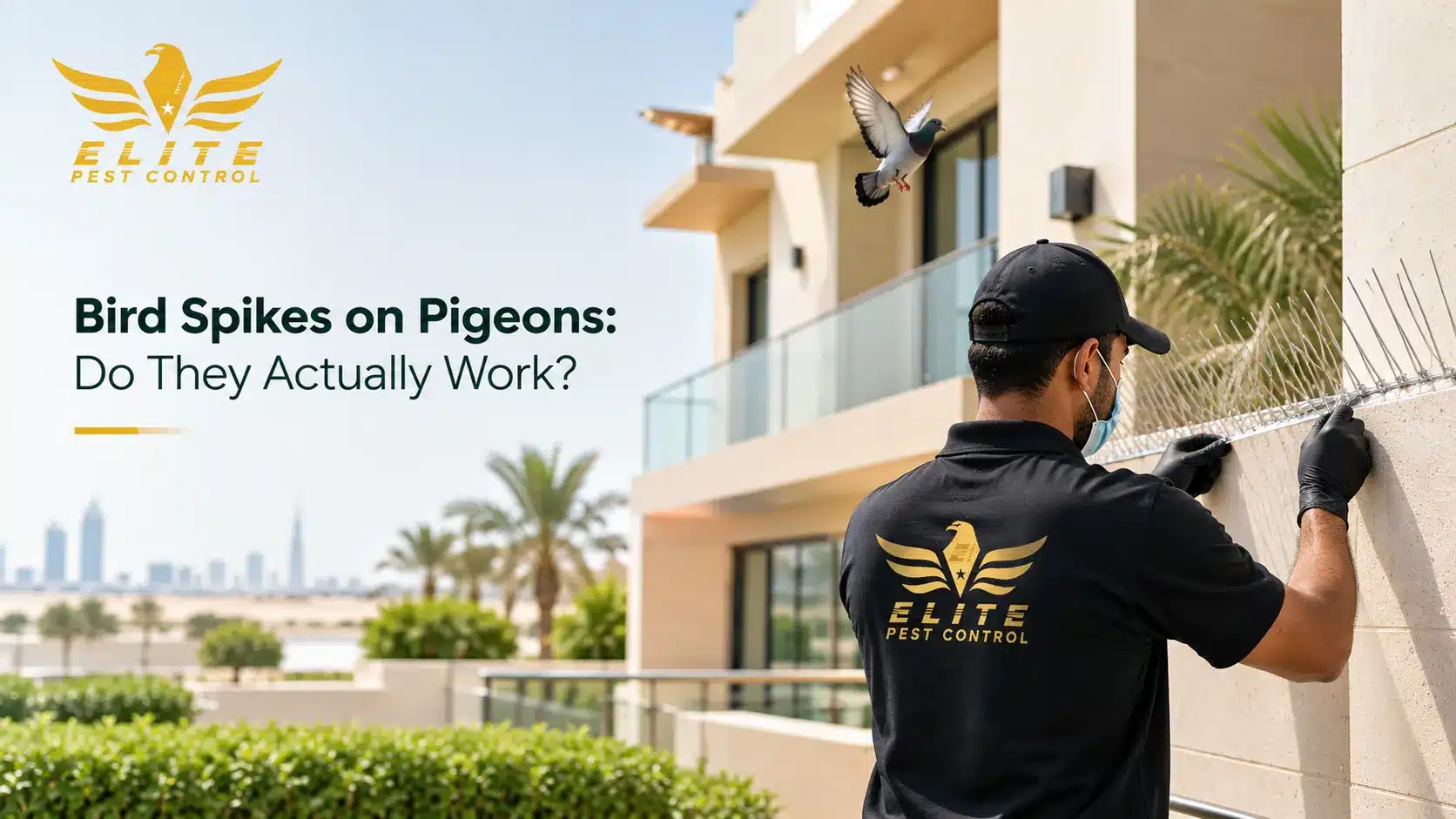
Bird spikes are rows of thin rods fixed to a surface so birds cannot find a flat place to land. They are designed to stop landing, not to injure. They work best against larger birds such as feral pigeons and gulls, whose feet cannot grip thin, spiky perches.
Spikes tend to work when:
- The surface is narrow and flat, such as a ledge, railing, parapet, beam or the top of a sign.
- They are fitted in full, continuous rows with no gaps.
- They are cleaned or checked regularly.
- Food, water and nest material nearby have been dealt with, so the birds have less reason to keep trying.
They tend to fail when:
- The area is wide or enclosed. Spikes do not seal an opening, so they are the wrong tool for closing off a whole balcony or recess.
- Leaves, debris, feathers, droppings or nesting material collect on them. Birds can then land on that layer or even build on it.
- The birds are smaller. Small birds with feet built for gripping twigs can use spikes as a perch.
- Food is still available nearby. The birds keep coming back and test every surface.
- Installation is poor. Loose, patchy or badly anchored spikes give birds somewhere to stand.
So the honest answer to the title: yes, on the right surface, and no as a stand-alone fix for a whole property. For a closer look at what we install, see our bird control service.
Where bird spikes suit a home
Think of spikes as a fix for places where a pigeon wants to stand. At a villa or apartment, that usually means:
- Balcony railings and parapet walls.
- Window ledges and sills.
- Roof edges and the tops of boundary walls.
- The flat tops of outdoor AC units, ducting and pipes.
- Beams, signs and light fittings.
Spikes are commonly made from stainless steel or polycarbonate (a tough plastic). In the UAE's heat and strong sun, ask the installer how the product copes with UV and high temperatures. Treat any lifespan claim on a product box as the seller's claim, not a guarantee.
Pros and cons of bird spikes
| Pros | Cons |
|---|---|
| No power, no moving parts and no chemicals. | They only cover the surface they are fitted on. Birds simply move to the next ledge. |
| A one-off fit that can last, if the product and installation are good. | Debris, droppings and nesting material can build up and give birds a place to land. |
| Suited to narrow ledges, railings and flat tops where pigeons like to stand. | Gaps, loose sections or bad anchoring let birds back in. |
| Specialised spikes are among the methods Abu Dhabi's invasive bird guide allows. | Smaller birds can perch on them, and they do not seal an opening. |
| Low upkeep compared with sprays or scare devices that need resetting. | They need regular checking and cleaning, and rows on a visible frontage can look untidy. The guide says methods should not spoil the general appearance of the city. |
How to get bird spikes to work
- Clean first. Remove old nests, droppings and debris from the surface before fitting anything. Spikes fitted over old nest material do not do their job. Use the safe cleaning steps below.
- Cover the whole perch. Fit continuous rows with no gaps, and make sure the spikes cover the full width of the ledge so a pigeon cannot stand beside them.
- Fix them firmly. Use a fixing that suits the surface. Loose or lifting strips give birds a foothold.
- Treat the neighbours. If you spike one ledge and leave the next one bare, expect the birds to move. Think about the whole row of perches they can reach.
- Check and clean regularly. In the UAE, dust and sand settle on surfaces fast. Look at the spikes every month or two, and clear debris and droppings before it builds up.
- Replace damaged sections. Bent, broken or lifted spikes need fixing, as they give birds a gap to use.
What Abu Dhabi's rules say about bird control
In December 2024, Abu Dhabi's Department of Municipalities and Transport, working with the Environment Agency – Abu Dhabi, published a guide on dispersing invasive birds. It covers six non-native species, including the rock dove, the wild ancestor of the feral pigeons you see around buildings. In plain terms:
- Poison, electricity and projectiles of any kind are banned for controlling these birds.
- Sound and visual scares, plus specialised spikes and nets, are allowed as long as they do not spoil the general appearance of the city.
- If a tenant, neighbour or other resident complains, property owners and managers must follow the guide.
- Gatherings of these birds can be reported through the Abu Dhabi Government Contact Centre or the Tamm portal.
- It also advises against littering, scattering grain or bird food, and keeping pigeon coops on rooftops.
This is general information, not legal advice. The announcement we read does not mention penalties, and rules can change. Check the current position with your community or property manager before fitting spikes on a shared building, and avoid DIY traps or poison.
Cut off the food and nesting spots
Spikes only move the problem if the birds still have a reason to be there. A feral pigeon keeps testing a spot for as long as food and shelter are easy to find. The official guide points to three habits: leaving litter, scattering grain or bird food, and keeping pigeon coops on rooftops. Add to that:
- Do not feed pigeons, and ask neighbours and household staff not to.
- Keep outdoor bins closed and clear food scraps from terraces and outdoor kitchens.
- Remove old nests and build-up from ledges and AC units, then fit the spikes straight away.
- Fix leaking pipes and AC drain lines that leave standing water.
Our home pest control checklist for Abu Dhabi is a handy general walk-through for the rest of the property.
Cleaning droppings safely
You have to clean a ledge before spiking it, so this matters. Wiping a windowsill is low risk for most people. Heavy droppings are different. Public health guidance, such as this county safety bulletin, names histoplasmosis and cryptococcosis (both fungal infections) and psittacosis (a bacterial infection) as pigeon-related. People with weakened immune systems are at higher risk and should not clean droppings themselves.
For a larger clean-up:
- Wet the droppings first. Do not dry sweep or blow them, because that puts dust in the air.
- Wear disposable gloves and a well-fitted mask. For heavy build-up, the same bulletin lists an N95 or higher respirator and eye protection as protective gear for workers.
- Scoop up the wet material, bag it in heavy-duty plastic bags and put it in the regular bin.
- Wash your hands and any exposed skin before eating or drinking.
- Wash the area again regularly so droppings do not build up.
When to call a professional
You can handle a single low ledge or railing yourself. Call a professional when:
- The ledges are high or hard to reach safely.
- There is a large flock, or heavy droppings build-up.
- A neighbour, tenant or property manager has complained.
- You have already fitted spikes and the birds came back.
- You are not sure whether spikes suit the surface.
- It is a commercial property, such as a restaurant or warehouse, where hygiene matters.
If you would rather have it handled for you, our bird control service page explains how a visit works and where we cover. If pigeons are only one of several pests at your villa, our guide on annual vs one-time pest control for Abu Dhabi villas may help you plan.
Frequently asked questions
Do bird spikes work on pigeons?
Yes, on narrow ledges, railings and parapets when they are fitted in full rows and kept clear of debris. They do not seal an opening, so they are not the right tool for closing off a whole space.
Do bird spikes hurt pigeons?
Spikes are designed to stop birds landing, not to injure them. Badly fitted or damaged spikes can still be a risk to birds, so use a trained installer. Electrified products are banned under Abu Dhabi's guide.
Are bird spikes allowed in Abu Dhabi?
Abu Dhabi's invasive bird guide lists specialised spikes among the allowed methods, provided they do not spoil the general appearance of the city. Check with your community or property manager before fitting them on a shared building.
Can pigeons nest on bird spikes?
They can if debris builds up. Birds can land on, or build in, a layer of nesting material, droppings or debris that collects on the spikes, so check and clean them regularly.
How long do bird spikes last?
It depends on the material, the heat and sun, how well they are fitted and how often they are maintained. Ask the installer what the product is rated for in UAE conditions, and treat a box claim as a seller's claim, not a guarantee.
Can I poison or trap pigeons myself?
No. Poison is banned under Abu Dhabi's guide for controlling invasive birds. Use deterrents such as spikes, or call a municipality-approved pest control company.
The bottom line
Bird spikes are a good tool for ledges, rails and flat tops, and a poor answer for wide or enclosed spaces. They work best when the surface is cleaned first, the rows are fitted without gaps, food and nests are dealt with, and the spikes are checked from time to time. If you are not sure whether spikes suit your property, a site visit will show you where the birds are landing and why.
Pigeons landing on your ledges or railings?
Book a free inspection and we will tell you whether spikes suit the spot.
Call +971 55 906 9032 WhatsApp Us
Email: info@elitedefencepestcontrol.ae
Office No. 18, Plot No 161, Al Jazzeem Building, Street 9, Musaffah M-37, Abu Dhabi, UAE
Book Now · Contact Us · Bird Control Services